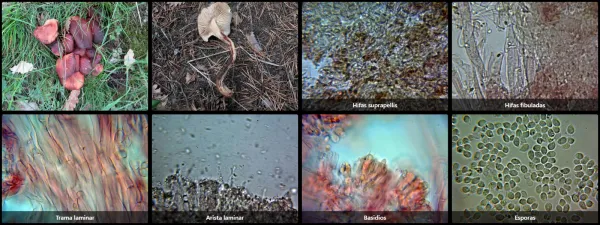
Gymnopus fusipes
Taxonomy
Main synonym
Common names
Collibia de pie fusiforme.
Geographic references:
Interactive map with data from GBIF.




Morphological Features:
Pileus 5 to 10 cm, convex when young, becoming somewhat irregularly flattened with age, occasionally slightly undulate. The cuticle is glabrous, and the color ranges from pale ochre at emergence to reddish-brown at maturity; it is also hygrophanous.
Lamellae rather distant from each other, broad and adnate to the stipe; pale when young, becoming stained brown with age, sometimes with reddish tinges.
Stipe central and fusiform, rooting towards the base, strongly longitudinally grooved, tough, reddish-brown in the basal region, becoming much paler towards the pileus.
Flesh very tough and even coriaceous, especially in the stipe, elastic, with a mild fungal odor and a sweet taste.
Habitat:
Grows fasciculate, always attached to stumps or trunks of broadleaf trees, sometimes saprotrophic and at other times parasitic. It can be found from spring through late autumn.
Observations:
The toughness of its flesh renders it inedible; however, it is a non-toxic species. We believe that its fasciculate growth habit, reddish-brown coloration, and grooved stipe make it unmistakable, although if encountered as a solitary specimen, it might bear some resemblance to Rhodocollybia prolixa var.distorta, or the twisted-stem collybia.