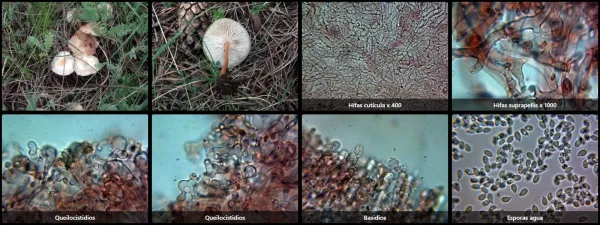
Gymnopus dryophilus
Taxonomy
Main synonym
Common names
Collibia de los robles, collibia temprana, haritz-marasmio, fals cama-sec.
Geographic references:
Interactive map with data from GBIF.




Morphological Features:
Pileus of small dimensions, reaching at most 5 cm in diameter; initially convex in shape, becoming nearly completely flattened, and occasionally slightly depressed at the center. Its color varies depending on the specimen's hydration state, ranging from a tawny-ochre when hydrated to a dry straw hue when desiccated. The surface is entirely smooth and becomes glossy when wet. It is hygrophanous, which sometimes causes it to appear slightly striate by transparency.
Lamellae thin and very crowded, whitish in color, occasionally with yellowish tints, adnate.
Stipe central and cylindrical, rather elongate; its color usually varies little from that of the pileus, if anything slightly darker. It is smooth, fibrous, and quite elastic.
Flesh scant and elastic, fibrous in the stipe, whitish in color, with a pleasant fungal odor and a sweet, mild taste.
Habitat:
This fungus forms true carpets in broadleaf forests, particularly under holm oak, although some varieties of it fruit in pine stands. Not only is it frequent and highly abundant, but it also emerges practically year-round, with the exception of the coldest period of winter.
Observations:
With the stipe removed, it can be consumed, but its culinary quality is very limited due to the scantness and elasticity of its flesh. Several varieties exist, some of which have been elevated to specific rank; however, in our modest opinion, they likely represent merely varieties. Such is the case with Gymnopus ocior=Collybia dryophila var. extuberans, or Gymnopus aquosus=Collybia dryophila var. Aquosa. Caution: do not confuse with the laxative Gymnopus hariolorum, which evidently does not possess as pleasant an odor as this species.