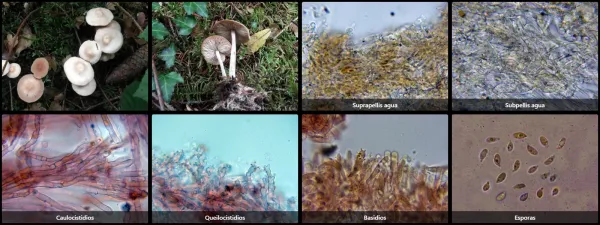

Collybiopsis confluens
Taxonomy
Main synonym
Common names
Collibia agrupada, marasmio mordoskatu.
Geographic references:
Interactive map with data from GBIF.

Morphological Features:
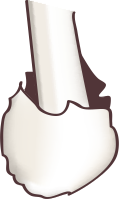
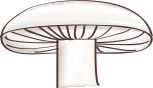
Pileus with a diameter ranging from 2 to 5 cm in adult specimens, bell-shaped at first, then convex and finally flattened, usually with an obtuse umbo. It is a slightly hygrophanous species, causing its color to vary depending on hydration, being reddish-brown when wet and fading to light clay tones upon drying; very young specimens may be somewhat grayish. Margin thin and regular when young, irregularly wavy when old, only slightly striate.
Lamellae adnate to nearly free, very crowded, whitish when young, then ranging from clay-colored to pinkish, with a serrate or crenulate edge.
Stipe very long relative to the pileus diameter, often laterally compressed or longitudinally grooved, otherwise simply cylindrical. It has a reddish-brown background color but is covered with a grayish pruina.
Flesh thin, scanty, whitish, more fibrous in the stipe but generally somewhat elastic in consistency. It has a rather penetrating odor and a sweet, pleasant taste.
Habitat:
The growth habit of this species is distinctive, fruiting in caespitose clusters, with multiple specimens always joined at the base of the stipe. It is typically found under broadleaf trees, especially beeches, during autumn months and less commonly in summer, although it can also occur under conifers. It should be considered a relatively uncommon species, although this varies depending on the geographic region.
Observations:
The pilei of young specimens constitute a quite respectable edible; nevertheless, perhaps due to lack of familiarity and scarcity, it is not a fungus collected for culinary purposes. It shares its habitat with another caespitose species, Gymnopus erythropus, which can be distinguished by its smooth, glabrous stipe that is much redder in the lower portion. It may be confused with many Marasmius species; indeed, it formerly belonged to that genus due to its appearance, but those species possess a hymeniform pileipellis structure.