
Gymnopus androsaceus
Taxonomy
Main synonym
Common names
Marasmio rosa, marasmius arrosa, marasmius pé de arame.
Geographic references:
Interactive map with data from GBIF.

Morphological Features:
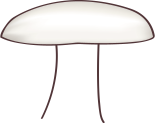
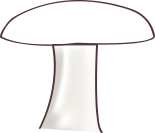
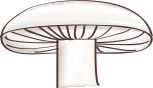
Pileus very small in size, its diameter rarely exceeds 1 cm, typically ranging between 0.5 and 1 cm. Hemispherical at first, soon becoming convex and finally plane-convex; it rarely flattens completely, and the central zone exhibits a slight depression that is more pronounced in mature specimens. Cuticle somewhat rugulose and radially striate or sulcate, ranging in color from reddish-brown to brown with pinkish tints, always maintaining a darker center than the remainder. Margin slightly and irregularly crenulate.
Lamellae adnate and rather distant from each other, lacking a collarium, ochraceous in color, more or less pale depending on the degree of maturation or hydration of the examined specimen.
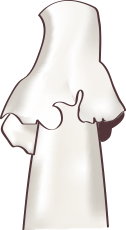
Stipe disproportionately elongated, filiform, practically black in color, with only the apex occasionally displaying different tones, which may be brownish or whitish. Rhizomorphs are frequently found at the base.
Flesh insignificant, pale ochraceous in color, fragile in the pileus and firm in the stipe, lacking any appreciable odor or distinctive taste.
Habitat:
This species typically appears in a gregarious manner, in groups of numerous individuals, being common in our coniferous forests and somewhat rarer under broadleaf trees. It appears primarily during autumn, although it can be found at other times of the year, fruiting on pine needles, leaf litter, and humus; it has occasionally been observed on woody debris as well.
Observations:
This small species is characterized by its gregarious growth habit, elongated black stipe, lack of a collarium, and absence of a significant odor. Marasmius (Mycetinis) scorodonius is very similar, but possesses a strong garlic odor; Marasmius splachnoides is perhaps the most similar, and can be distinguished from it macroscopically by its whitish lamellae. There are many other species that must be carefully examined to differentiate them from the one described here.