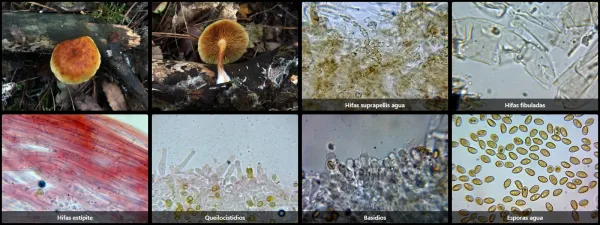

Gymnopilus penetrans
Taxonomy
Main synonym
Common names
Gymnopilo penetrante, egur ziza zola-zuri, foliota pequeña dos pineiros
Geographic references:
Interactive map with data from GBIF.
Morphological Features:
Pileus that can reach an acceptable size but is highly variable; we have found fully developed specimens measuring merely 3 cm in diameter alongside others reaching 6 or 7 cm. Convex during early stages, later becoming flattened, with a raised central zone or obtusely umbonate. Cuticle briefly radially fibrillose, yellowish-ochraceous to tawny, sometimes nearly yellow when dry, paler toward the margin, and separable for approximately two-thirds into the flesh. Margin regular and thin, slightly undulate in older specimens.
Lamellae adnate and relatively crowded, especially in young specimens, later becoming somewhat more distant, dull yellowish in color but randomly spotted with rusty patches. Lamellar edge irregularly serrate, slightly paler than the rest of the lamellae.
Stipe central and cylindrical, proportionate to the pileus size or more typically elongated, similar in color to it, fibrillose to smooth with development. Occasionally it may exhibit an annuliform zone, but in most cases lacks one, with a whitish mycelial base.
Flesh thin and quite fibrous, pale yellowish in color, nearly white in the stipe and ochraceous when old. It possesses a rather weak, fungal odor, but its taste is distinctly bitter.
Habitat:
This is a highly frequent and abundant species in our coniferous forests; under Pinus radiata it can form true carpets. It fruits on wood or decaying woody debris, behaving as a saprotroph; therefore, it does not grow on living trees and often appears to be growing directly from the soil. It may appear at any time of year provided weather conditions are favorable; in fact, there are occasions when this is the only species observed throughout an entire morning's foray in the forest.
Observations:
A highly abundant species characterized by the yellowish or tawny tones of the entire basidiocarp, its lignicolous habitat on conifers, and its bitter taste. It can be identified with relative ease macroscopically. It may be confused with Gymnopilus suberis, which is very similar but occurs on cork oak wood (Quercus suber), or with other lignicolous species sharing its habitat such as Flammula pinicola, which typically grows in clusters on stumps, or with the deadly Galerina marginata. It is highly unlikely to be confused with edible species, and due to its bitter taste, it possesses no culinary value whatsoever.