Gymnopilus junonius
Taxonomy
Main synonym
Common names
Seta de la risa, foliota anaranjada, egur-ziza bikain.
Geographic references:
Interactive map with data from GBIF.




Morphological Features:
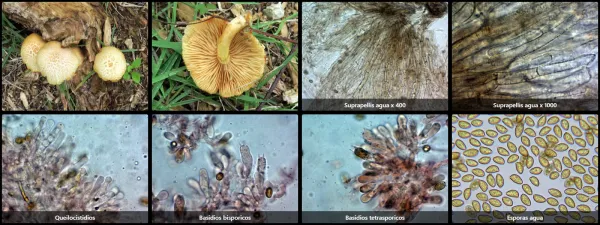
Pileus of substantial dimensions; specimens measuring up to 20 cm in diameter have been recorded, though typically ranging from 10 to 15 cm. Initially hemispheric, later convex, occasionally with an obtuse umbo. Ochre-buff to leonine, sometimes with faint reddish hues; the surface is finely squamulose or fibrillose, lacking coarse, prominent scales. Margin non-striate and involute in young specimens.
Lamellae adnate to more typically sinuate, moderately spaced and regular. Color varying from yellow in youth to ferruginous-brown with maturity, staining reddish upon handling.
Stipe elongate and frequently flexuous, occasionally fusoid, otherwise cylindrical and tapering toward the base. Yellowish-ochraceous, fibrillose, becoming reddish toward the base. Provided with a well-defined, concolorous membranous annulus, which eventually turns rust-colored and tends to become adnate.
Flesh thick and firm, whitish to pale yellow; odor slightly radish-like but mild and not unpleasant; taste markedly bitter.
Habitat:
A relatively common species, frequently occurring in caespitose groups on stumps of both broadleaf trees and conifers. Fruiting from late summer throughout autumn.
Observations:
This species contains psychoactive compounds that induce effects resembling intoxication. However, its complete chemical profile has not been thoroughly investigated, rendering it potentially hazardous. Confusion with other Gymnopilus species is unlikely due to their significantly smaller stature; however, it is frequently mistaken for certain Pholiotas, which typically possess a pileus adorned with coarse, pyramidal scales.