Guepiniopsis buccina
Taxonomy
Main synonym
Common names
Not available
Geographic references:
Interactive map with data from GBIF.




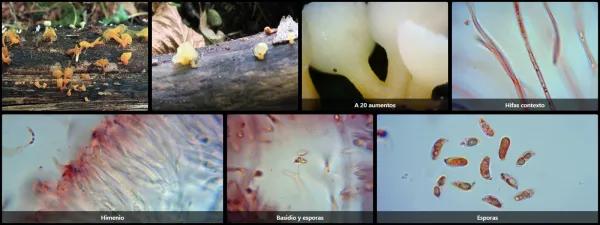
Morphological Features:
Fruiting body small, referenced to reach up to 3 cm in height, although our specimens barely reached half that size at best, with a diameter barely reaching 0.5 cm at the upper region. They adopt various shapes, being either patelliform or cup-shaped, although young individuals typically assume a periscope-like form. These fruiting bodies are divided into two perfectly differentiated zones: a more compact upper portion constituting the fertile part, and a very evident sterile stipe. The entire structure exhibits a striking bright orange-yellow coloration that becomes more muted with age.
Hymenium located on the inner upper surface of the fruiting body, yellow and smooth. The entire external surface of the cup is, however, finely granular and features characteristic striations that extend down to the stipe. The margin is usually somewhat undulate or crenulate.
Stipe evident and concolorous, cylindrical, barely 0.5 cm long, usually bearing longitudinal striations, particularly in the upper portion.
Flesh waxy in appearance and gelatinous to the touch, not as fragile as it appears, and its color is similar to that of the external surface.
Habitat:
A species that fruits on the wood of various broadleaf trees, generally growing in gregarious clusters, and has the peculiarity that occasionally several fruiting bodies may arise from the base of a single stipe, although finding individual fruiting bodies is more common. Specimens were located in autumn by our friends and collaborators Juan Ginés and Duende, although its occurrence is also possible at other times of the year. A species to be protected due to its scarcity.
Observations:
The genus Guepiniopsis comprises very few species; we confirm the referenced presence of only 4 species in the European region, of which Guepiniopsis buccina is undoubtedly the easiest to recognize. Guepiniosis chrysocoma also occurs at these latitudes but features cushion-shaped fruiting bodies without an evident stipe. Macroscopically, there is a high risk of confusion with the genus Hymenoscyphus, which comprises even smaller species, many of them also yellow in color, but let us not forget that they belong to the Ascomycetes.