Guepinia helvelloides
Taxonomy
Main synonym
Common names
Oreja de vaca, mukiziza gorri, cresta de gallo.
Geographic references:
Interactive map with data from GBIF.





Morphological Features:
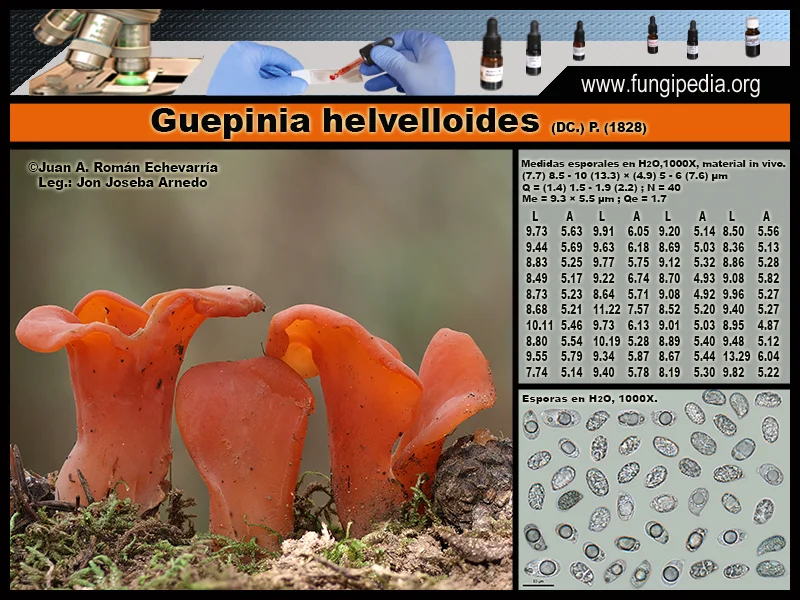
Fruitbody growing singly, not clustered, formed by a kind of ear-shaped receptacle in its most typical form, although it may adopt other less defined shapes; in any case, always laterally open. It can reach notable dimensions, approaching 10 cm in height, though it is usually found around 5 cm tall, with a width between 2 and 5 cm. It has a striking color, reddish-orange sometimes with a pinkish tinge, becoming reddish-brown when old. Surface shiny, smooth, and glabrous, pruinose, however not viscid, and the margin is lobed and irregularly undulate.
Hymenium smooth and concolorous, lining the inner surface of the fruitbody; the production of a white spore print gives the hymenial surface a pruinose appearance.
Stipe which is nothing more than a simple prolongation of the pileus that clearly tapers towards the base; it usually has a similar color except precisely at the base, which is whitish.
Flesh of gelatinous consistency, with a certain thickness and a paler color than the external surface. Its odor is mild and pleasant, its taste sweet but faint; it has very little flavor.
Habitat:
It is an infrequent species that fruits on buried woody debris, appearing to emerge from the soil. It primarily fruits in coniferous forests; under pines it is usually found in the northern part of the Iberian Peninsula. We have only verified one record from the south, reported by our friends José Antonio Rodríguez and Manuel Núñez under Abies pinsapo in the Sierra de Grazalema. An autumnal species that typically fruits in groups, becoming winter-fruiting at more southern latitudes.
Observations:
It is an edible species that can be consumed raw in salads, although we must note that it has very little flavor. It is characterized by its striking reddish color, its laterally split form, and the gelatinous, translucent consistency of its flesh. Due to its vivid colors and other macroscopic characters, we consider it a species unlikely to be confused with others.
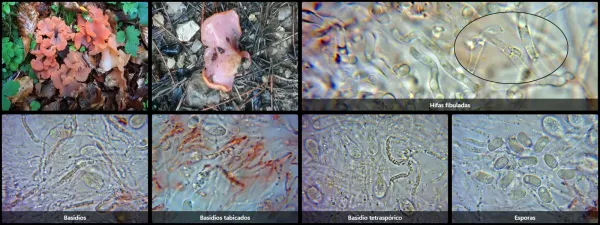
Microscopy of Guepinia helvelloides