
Grifola frondosa
Taxonomy
Main synonym
Common names
Poliporo frondoso, Maitake, Hen of the Woods, ardagai erraldoi, gírgola de castanyer.
Geographic references:
Interactive map with data from GBIF.
Morphological Features:
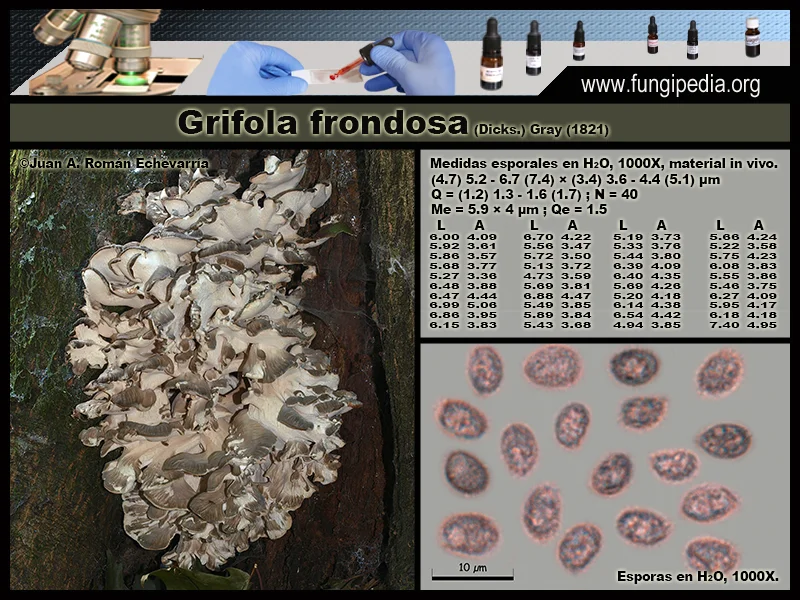
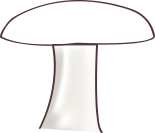
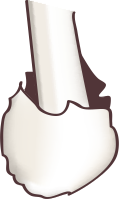
Basidiocarp composed of a generally solid whitish base, not always visible as it is sometimes embedded within the substrate, from which numerous caps arise. These caps open and spread in an imbricate yet distinct arrangement, fused to one another but individually separated. Each cap initially develops in a tongue-like shape and subsequently expands more broadly like a fan; in its early stage the margin is rounded, later becoming expanded, reaching up to 6 cm in length. The cap surface is fibrillose, these fibrils imparting a grayish hue over a lighter background, although some specimens develop a more brownish tone. The entire structure forms a mass that can attain considerable dimensions, spreading more horizontally than vertically or vice versa as in our collection, potentially reaching 50 cm.
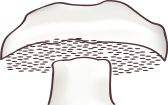
Hymenium composed of white tubes, short, not exceeding 2 to 3 mm in length, and whitish pores numbering 2 to 4 per mm. The pores are initially rounded, becoming more angular with age, extend in a decurrent manner, and remain completely unchanging upon rubbing.
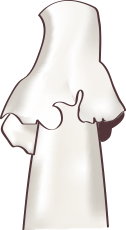
Stipe truly absent; the caps do possess a prolongation that serves to connect them with adjacent caps, but this is not a true stipe, nor should we consider the base attaching the entire structure to the substrate as such. There does exist a form, Grifola frondosa f. intybacea, which bears fewer caps and possesses a structure more resembling a stipe.
Flesh of medium thickness, initially soft but becoming tough and elastic in mature specimens, whitish and unchanging upon cutting. Odor is mildly fungal when young, somewhat stronger in older specimens; flavor is mild and rather indistinct.
Habitat:
A species uncommon in the wild, but cultivated in many regions for primarily medicinal purposes, and to a lesser extent, culinary ones. It typically fruits at the base of living trees, commonly broad-leaved species such as chestnuts or oaks, although not exclusively, causing white rot. It is a parasitic species that appears to also exhibit saprotrophic behavior. Our collection was made in the Ganguren forest in Galdakao (Biscay), at the base of a living American oak tree (Quercus rubra). This species exhibits rather erratic fruiting patterns, as it does not typically fruit every year but rather every 3 to 4 years, generally during autumn as in our case.
Observations:
There is a long tradition in Eastern countries of using this species for medicinal purposes; numerous properties are attributed to it, some verified and others more characteristic of popular quackery. Therefore, information must be carefully evaluated before consuming these preparations, as it remains a therapeutic agent regardless of its natural origin. Rigorous studies do demonstrate its benefits as an adjunct to standard treatments for certain cancers, reducing the side effects of chemotherapy, or acting as an inhibitor to reduce the likelihood of metastasis, although it does not cure the disease itself. Only very young specimens are edible, as the flesh becomes tough. It closely resembles Meripilus giganteus, which has much larger caps and flesh that darkens markedly, as well as Polyporus umbellatus, which does form complete individuals with well-differentiated caps and stipes.
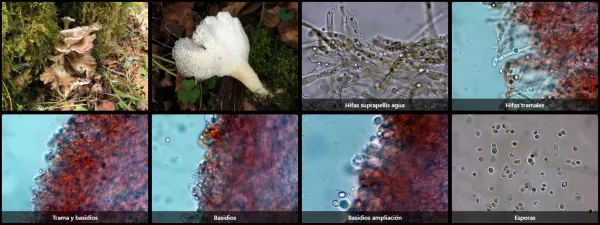
Microscopy of Grifola frondosa