

Gomphidius roseus
Taxonomy
Main synonym
Common names
Gonfidio rosa, lerdeki arrosa.
Geographic references:
Interactive map with data from GBIF.




Morphological Features:
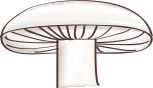
Pileus small for its genus; adult specimens typically range from 2 to 4 cm in diameter, occasionally up to 5 cm. Initially convex at emergence, it later flattens and may become slightly depressed in more mature specimens. The surface color is strikingly vivid: an intense red with a pinkish hue, fairly uniform, contrasting markedly with the rest of the white fruit body. The cuticle is shiny and somewhat viscid when wet, smooth and glabrous, with an involute margin in younger individuals that becomes reflexed in mature specimens.
Lamellae decurrent, widely spaced, very thick and waxy in appearance; initially nearly immaculate white when young, turning dark gray with lilac or olivaceous tints upon spore maturity.
Stipe short, often barely exceeding 2 cm in length, solid and tapering toward the base. White in color, occasionally showing pinkish tints in parts and a yellowish mycelial zone at the base. Bears a conspicuous concolorous veil in young individuals, almost ring-like, which with age tends to persist as an adherent, web-like remnant.
Flesh thick and firm for such a small mushroom, white in color, pinkish beneath the cuticle. Mild and sweet in taste, with a barely perceptible odor.
Habitat:
This species has consistently been observed under the same circumstances without exception, in pine forests and directly associated with the mycelia of Suillus bovinus. It remains to be elucidated whether the relationship between the two species is symbiotic or parasitic; however, initial observations indicate that Suillus mycelia continue to fruit in subsequent years, suggesting that the emergence of Gomphidius roseus does not adversely affect them. It is a very rare species that we have always encountered during autumn.
Observations:
A gilled species within the Boletales characterized by its striking intense red and shiny color, small size, and consistent growth in association with the mycelia of Suillus bovinus. Confusion with other species is unlikely; only Chroogomphus fulmineus exhibits a similarly striking reddish color, but that species can be up to three times larger, and its lamellae and stipe are not white.