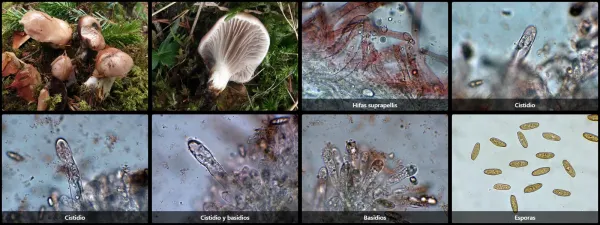

Gomphidius maculatus
Taxonomy
Main synonym
Common names
Gonfidio manchado, alertze-lerdeki.
Geographic references:
Interactive map with data from GBIF.


Morphological Features:
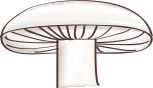
Pileus with an average diameter of about 5 cm; occasionally, some specimens may approach 10 cm while others barely reach 3 cm. Initially convex with a slightly gibbous center but not umbonate, it flattens with age, and the central zone may even become somewhat depressed. The surface is viscid in wet weather but not glutinous, appearing slightly satiny and dry when rain-free. It is whitish with a grayish tinge in young individuals, staining black or brownish-pink upon handling; towards the end of its life cycle, the dark color prevails as the initial white fades. Margin involute in young specimens.
Lamellae decurrent, thick, and relatively distant; initially whitish, staining pink to reddish in damaged areas. They exhibit a marked tendency to blacken, becoming practically black in more mature specimens.
Stipe proportionate to the pileus, slender and slightly attenuated at the base, solid. White in color, particularly evident in the upper third, as the remainder is covered with brownish scales that blacken, eventually turning a dirty brown over time. It is not viscid, and the base stains distinctly yellow.
Flesh rather thick and firm, whitish in color, slightly tinged pink beneath the cuticle in mature specimens, and turning yellow to vinaceous at the base of the stipe. It lacks a perceptible odor, and its taste is mild and sweet.
Habitat:
This is a fungus that forms mycorrhizae exclusively with larches (Larix sp). It generally fruits in small groups from late summer through autumn. We commonly observe it annually in plantations of Larix kaempferi (Japanese larch) at elevations of 600 to 800 meters above sea level; within this exclusive habitat, it is a fairly frequent species.
Observations:
The species presented here is characterized by its medium size, its exclusive habitat under larches, and its marked tendency to redden and blacken. Gomphidius glutinosus is larger, lacks a tendency to blacken, has a mucilaginous stipe, and its base is more distinctly yellow than in the species described in this profile. Gomphidius gracilis is treated by some authors as an independent species due to its unchanging lamellae; we consider it to be a variety of the same species.