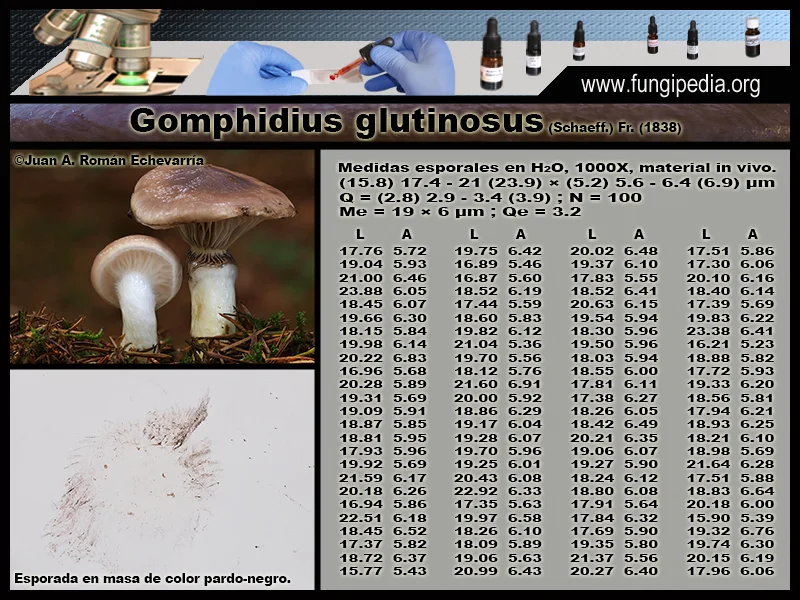

Gomphidius glutinosus
Taxonomy
Main synonym
Common names
Gonfidio mocoso, gonfidio glutinoso, lerdeki hankahori, cama de perdiu mocosa, chiodetto.
Geographic references:
Interactive map with data from GBIF.


Morphological Features:
Pileus of good size, the diameter of adult specimens usually ranges generally between 5 and 10 cm, occasionally somewhat larger. In its early stages it is convex in shape, even hemispherical in primordia, but soon flattens out, maintaining a raised center in some specimens, while others tend to become slightly depressed at the center. Cuticle very viscid, glutinous when wet, easily separable from the flesh; when young, brown with clear violet tints that fade in maturity, leaving a fairly uniform grayish-brown tone except for the center, which is usually somewhat darker. Margin incurved and bearing remnants of the veil initially, later expanded and thin.
Lamellae very decurrent on the stipe, spaced and with few lamellulae; initially whitish, then grayish, and finally nearly black as a result of sporulation. The spore print in mass is dark purplish. When young, they are covered by a whitish veil connecting the pileal margin to the stipe, which tends to disappear.
Stipe mostly elongated or sometimes proportionate to the pileus; white and dry in the upper region, leading down to a viscid annular zone formed by remnants of the veil that once connected it to the pileus. These remnants are initially prominent and whitish but stain purple upon spore deposition. Below this annular zone, the stipe is scaly and viscid, staining yellow from the base. It is cylindrical, but the region of attachment to the mycelium tends to be radicate.
Flesh quite thick and white, yellowish at the stipe base, with a tendency to gray slightly; it has a fairly good texture, with a mild fungal odor, but when cooked it is somewhat insipid, while its raw taste is slightly acidulous.
Habitat:
We are dealing with a relatively uncommon species, very rare under broadleaf trees. Within our area of study, it is a species we usually encounter annually at several locations, forming mycorrhizal associations with Picea abies forests; according to the literature, this is its preferred habitat, and at one of these sites it is abundant. Where it occurs, it typically does so in small groups, rarely solitary, being an eminently autumnal species that we have not observed during other times of the year. The specimens subject to this study were located in Gillerna (Álava), in a mixed forest of Picea abies and Pseudotsuga menziesii (Douglas fir).
Observations:
The genera Gomphidius and Chroogomphus, despite comprising species with lamellae, belong to the order Boletales. The species presented here is edible but without notable culinary merit; moreover, given that it is rather scarce, we do not recommend its consumption in order to preserve it. This species is relatively easy to identify by its macroscopic features: its viscid pileus, very decurrent lamellae, viscid annular zone, and stipe yellowing at the base are sufficient to identify it without difficulty. Chroogomphus rutilus is a related species, but of a completely different coloration.
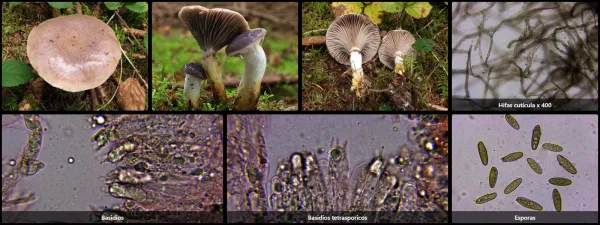
Microscopy of Gomphidius glutinosus