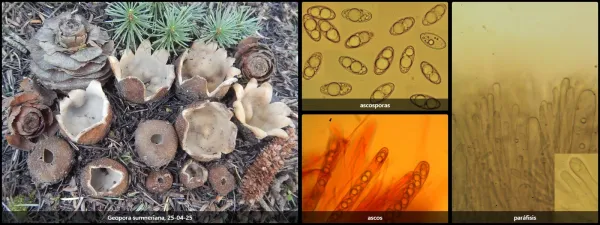
Geopora sumneriana
Taxonomy
Main synonym
Common names
Geopora de los cedros, Zedro-katilu.
Geographic references:
Interactive map with data from GBIF.





Morphological Features:
Fruiting body initially globose and nearly completely buried, it gradually emerges while adopting a dome-like shape, finally breaking through the surface and opening into more or less stellate lobes without becoming flattened. At maturity, its diameter may exceed 5 cm, although unopened specimens typically measure only 2 to 3 cm.
Peridium brown in color and entirely covered externally by dense, long brownish hairs. In young specimens, these hairs form a conspicuous felt-like mat. With age, they tend to exfoliate, particularly on the upper portion of the ascoma.
Hymenium lining the internal surface, contrasting sharply with the remainder of the fruiting body due to its much paler coloration, ranging from cream to light gray. It is entirely smooth and devoid of the external hairs. Both asci and spores are remarkably large, with spores measuring up to 30–36 µm in length by 15 µm in width.
Flesh relatively thick yet brittle. Odor is virtually absent, with only a faint scent of the earthen substrate detectable; it is essentially tasteless.
Habitat:
Literature classifies this species as spring-fruiting, though it has also been observed during mild winters; we have recorded it in March and April. It is characterized by an exclusive habitat under cedars, where it is fairly common. However, we must note that cedars are scarce in our region, occurring mostly as ornamental plantings in public gardens. It typically fruits in large clusters.
Observations:
This ascomycete is primarily distinguished from similar taxa by its exclusive occurrence under cedars; furthermore, in cases of doubt, a simple examination of spore size will resolve it. Geopora arenicola is less common, occurring on sandy soils and possessing much smaller spores. Another somewhat similar species is Humaria hemisphaerica, which features verrucose spores.