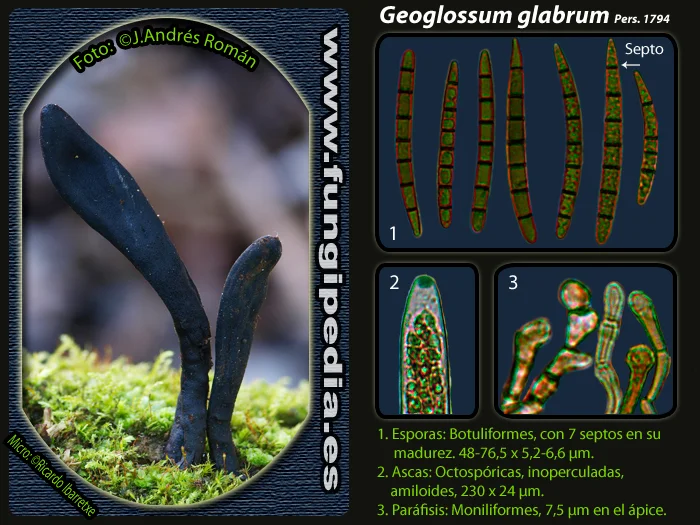
Geoglossum glabrum
Taxonomy
Main synonym
Common names
Not available
Geographic references:
Interactive map with data from GBIF.





Morphological Features:
Fruit body reaching a height of up to 5 cm, occasionally somewhat more, with a structure composed of two distinct but continuous parts. The upper head-like part constitutes the fertile portion of the fruit body, spanning about one-third of the total length or slightly less, black with a certain bluish sheen, rounded apex, generally laterally compressed and with a more or less cleft central groove, this being a somewhat variable character. Surface dry and shiny, never viscid, pruinose and glabrous.
Hymenium coating the upper fertile head, smooth and glabrous, concolorous, giving it a pruinose appearance upon maturity.
Stipe not truly distinct, as there is no sharp boundary separating it from the head; rather, it is a continuation of it. This entire zone is sterile, cylindrical and elongated, similar in color to the upper part, and likewise smooth and dry, though somewhat shiny in rainy conditions.
Flesh of the same color as the external surface, not as fragile as it may seem, even somewhat tough or elastic. Lacks any noticeable odor and has virtually no taste.
Habitat:
This species preferentially fruits in pine forests or in open terrain, generally in areas close to the coast, even in dune pine forests, sandy and mossy areas. It can grow solitarily or in small groups, with its favorite fruiting season being late autumn and especially winter. An uncommon species with an acidophilic tendency.
Observations:
The genus Geoglossum comprises species with great morphological similarities that are consequently difficult to separate macroscopically. Geoglossum umbratile is very similar and, like this species, mostly has spores with seven septa; however, its asci are noticeably smaller, up to 200 µm, whereas the species discussed here can reach 250 µm. Geoglossum cookeanum is almost identical, which is why its taxonomic status is controversial, though its asci are also somewhat smaller. Other Geoglossum species possess spores with many more septa, up to 17 in some cases. By its shape, it can also be confused with Xylaria polymorpha, but the latter has white flesh when cut.
Microscopy of Geoglossum glabrum