Gautieria trabutii
Taxonomy
Main synonym
Common names
Not available
Geographic references:
Interactive map with data from GBIF.





Morphological Features:
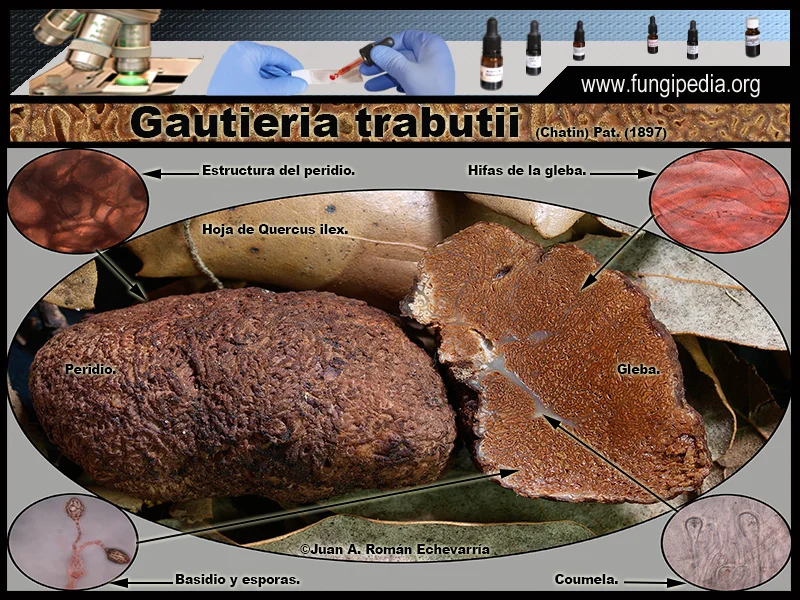
Basidiocarp rather small in size; the diameter of mature specimens usually ranges from 2 to at most 5 cm, with an irregularly tuberculate shape, sometimes subglobose, but more commonly forming various lobes or protuberances. Its color also varies depending on specimen maturity and the amount of peridium retained, ranging from whitish in very young specimens to those with ferruginous tones, or directly the predominant earthy ochre color upon peridium loss. A whitish, elastic mycelial cord is commonly present at the base, which may be absent depending on how the specimen is extracted.
Peridium composed of globose cells or spherocysts, extremely thin, only between 0.2 and 0.5 mm thick; furthermore, it is evanescent and readily sloughs off, a trait quite common in species of the genus Gautieria. It is typically whitish or cream-colored, readily stained with ferruginous tones, and upon disappearing reveals ochre cavities originating from the gleba.
Gleba upon sectioning exhibits an earthy ochre color that evolves to ferruginous ochre; only very young specimens display whitish or grayish tones. It is initially composed of closed locules, which become more open with maturity, along with a generally evident dendroid columella that originates from the base and expands in the form of gelatinous fibers with a translucent appearance.
Flesh absent as such; the texture associated with the gleba is rather cartilaginous, though quite tenacious. It has a faint odor initially, which becomes strong and not very pleasant upon maturation, quite different, in our view, from that of true truffles. Its flavor, although sweet, is also unpalatable.
Habitat:
This is a rather rare or poorly documented species, first recorded in the Iberian Peninsula in 1996. Since then, several collections have been made, confirming that the original description linking it exclusively to cedars is incorrect, as it is much more cosmopolitan, occurring under both conifers and Quercus. It exhibits hypogeous growth, but upon maturation typically emerges to the surface in a semi-hypogeous manner. It prefers acidic soils and siliceous substrates, where it fruits either solitarily or in small groups, with its preferred fruiting period being spring or early summer. Our collection was made in June, under Quercus ilex in the province of La Rioja.
Observations:
A species without culinary value. Given the difficulty involved in differentiating, both macroscopically and microscopically, among the various species of the genus Gautieria, this one may be the easiest to identify due to the presence of characteristic warts on the outer ridges of the spores. Gautieria morchelliformis is very similar, but often completely lacks a peridium, and its spores typically well exceed 20 µm; Gautieria graveolens or Gautieria othii are also similar, but neither possesses warts on the spore ridges.
Microscopy of Gautieria trabutii