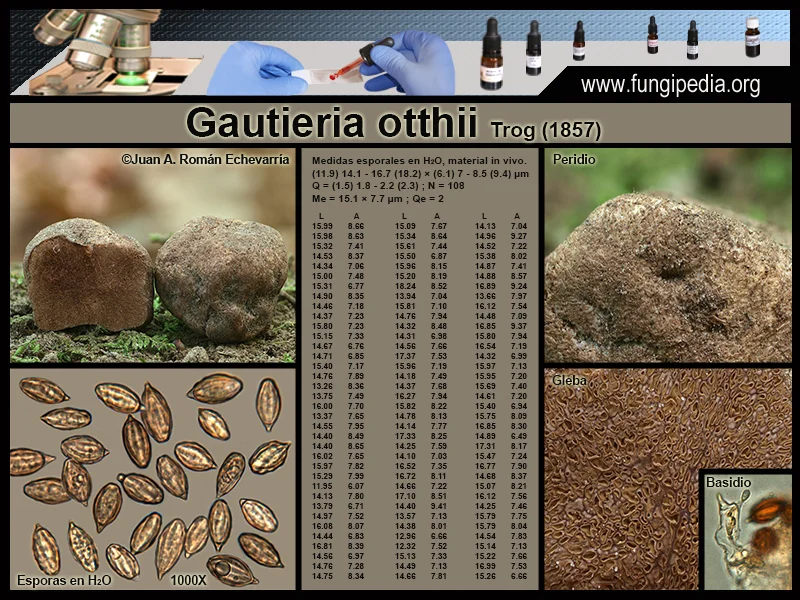

Gautieria otthii
Taxonomy
Main synonym
Common names
Not available
Geographic references:
Interactive map with data from GBIF.





Morphological Features:
Basidiocarp with a tuberculate or small potato-like shape, typical of most hypogeous or semi-hypogeous fungi. Sometimes somewhat globose or subglobose, but usually quite irregular in form, with some prominences or swellings; species of this genus lack a basal cavity. It measures between 2 and 5 cm in diameter, averaging around 3 cm, and typically exhibits whitish mycelial cords at the base that serve as connections to the mycelium. The color is fundamentally cream, with olivaceous tints, fairly uniform overall, although it tends to darken upon maturation.
Peridium extremely thin and of low persistence; it is very common to find specimens of this species with partially missing peridial fragments, revealing the gleba. However, we have not encountered any in which it has disappeared completely, as occurs in Gautieria morchelliformis, even in the most mature specimens. It is smooth, glabrous, and cream-colored.
Gleba composed of chambers that impart a labyrinthine appearance. The chambers are more tightly closed in immature specimens but gradually open with maturation, leaving internal cavities. Initially cream-colored, it becomes ochraceous upon development. The columella is clearly visible only in the basal region and is whitish-grey.
Flesh, which is essentially the gleba itself, is firm and tenacious with a cartilaginous texture. The odor is not particularly pronounced initially but becomes very intense with maturation, to the point of being unpleasant; the taste is likewise unpalatable.
Habitat:
This is a hypogeous species that fruits buried in both acidic and calcareous soils, typically within pine forests. Regarding its fruiting period, depending on latitude, it may appear almost year-round and is not strictly an autumnal species. In the specific case of our collection, it was gathered in May on acidic soil under Pinus sylvestris in the province of La Rioja. Besides the inherent difficulty in locating this type of fungus, this particular species can be considered rare in our region, which explains its limited documentation.
Observations:
The genus Gautieria within our study area comprises barely half a dozen species; the remainder occur at other latitudes. These species exhibit considerable macroscopic similarities, making detailed microscopic examination indispensable for accurate classification. Their spores typically resemble cacao pods in shape. Gautieria morchelliformis is very similar but readily loses its entire peridium early on, and its spores may exceed 20 μm. Gautieria graveolens, formerly synonymized with otthii, possesses spores intermediate between these two species. Gautieria trabutii features multiple warts along the ridges of its spores.
Microscopy of Gautieria otthii