Gautieria graveolens
Taxonomy
Main synonym
Common names
Not available
Geographic references:
Interactive map with data from GBIF.





Morphological Features:
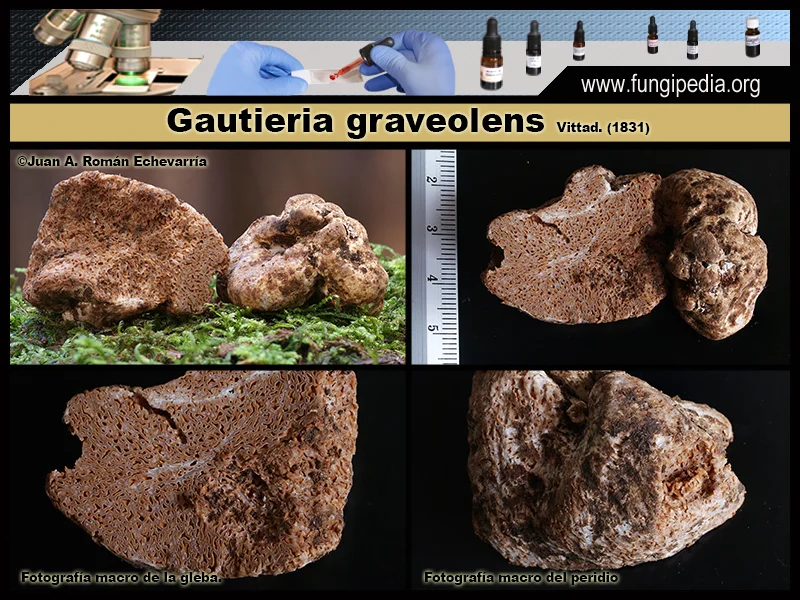
Basidiocarp exhibiting distinctly irregular forms, often subglobose, but at other times displaying irregular bulges without a specific shape. Its size varies, with mature specimens reaching up to 5 cm in diameter at their widest point, while others barely attain 2 or 3 cm. It is ferruginous-ochre throughout, and at the base features clustered white mycelial cords that serve as attachment points to the main mycelium of the same color.
Peridium composed of pale spherocytes, whitish overall, which impart a lighter appearance to very young specimens. These spherocytes begin to disintegrate early, revealing the gleba, but not uniformly; specimens at an intermediate stage of development show areas retaining the peridium alongside others where the gleba is more exposed. Only fully mature specimens completely lack a peridium.
Stipe absent; attached directly to the substrate via mycelial cords.
Gleba firm, non-pulverulent, with a labyrinthine appearance, composed of ferruginous-ochre chambers separated by white to grayish gelatinous septa that converge toward the base to form the columella. In mature specimens, an intense odor develops a few hours after collection, becoming unpleasant, particularly in enclosed spaces, and detectable at a distance.
Habitat:
A predominantly spring-fruiting species, appearing buried or semi-hypogeous in humid coniferous and broadleaf forests of the submontane zone. An elusive species that should be considered rare.
Observations:
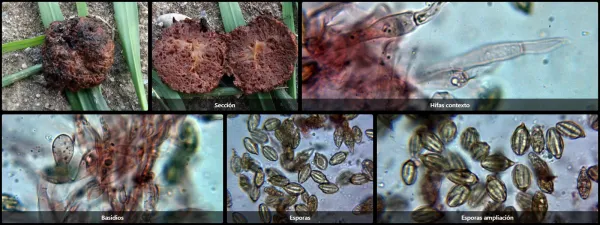
A not widely known genus, Gautieria comprises barely half a dozen species recorded for Europe. We have observed that young specimens are practically odorless upon collection, but after some time they emit an intense odor. Gautieria otthii is macroscopically similar to the species described here, to the point that some authors tend to synonymize them; however, their microscopic differences are significant, starting with spore size: 11 to 14 μm in G. otthii, whereas in the species described herein, spores predominantly range between 16 and 19 μm. Gautieria morchelliformis lacks a peridium from an early stage, and its spores are even larger.
Microscopy of Gautieria graveolens