

Galerina terrestris
Taxonomy
Main synonym
Common names
Not available
Geographic references:
Interactive map with data from GBIF.




Morphological Features:
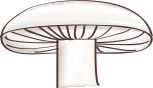
Pileus very small, with the diameter of fully developed specimens barely reaching one centimeter. Initially hemispherical, then subglobose, eventually becoming convex, a shape it retains until maturity without ever flattening. Young and well-hydrated specimens exhibit a warm reddish-brown hue, but as they desiccate, they become distinctly ochraceous, starting from the apex. The surface is smooth and almost entirely radially striate by transparency when young, except perhaps for the darker central area. The margin is broadly crenulate and somewhat irregular.
Lamellae adnate to ascending, interspersed with some lamellulae, ferruginous-ochre in color, with a ciliate margin.
Stipe elongated, though not as much as in other Galerina species, generally measuring around 3 centimeters. Notably fibrillose throughout, although older specimens may lose these fibrils and become nearly glabrous; it is also pruinose, particularly on the upper half. Reddish-ochre in color, though the area near the base is more brownish; it is more elastic than is typical for the genus. Fistulose from a young age.
Flesh scant and lacking firmness, ochraceous in color, with no remarkable odor or taste.
Habitat:
An extremely rare species with a muscicolous habitat, associated with mosses of the genus Rhacomitrium, with a particular preference for Rhacomitrium canescens. It primarily fruits in gregarious clusters on acidic soils that may have a somewhat sandy yet mossy consistency, which is somewhat unusual. The collected specimens were found in May in the Burgos locality of Rabanera del Pinar, although we do not rule out its occurrence at other times of the year.
Observations:
Despite an extensive search, we have found only one record of this species for the Iberian Peninsula, cited in November 2005 from Serón de Nágima, Soria, not too far from our collection site, although it is always possible that others have collected it without our knowledge. There are several species within the genus Galerina with which it shares some resemblance; for example, Galerina vittiformis, which has a longer stipe, a non-crenulate pileal margin, and a whitish, frosted lamellar edge. Galerina Hypnorum is very similar, even in stipe coloration, but its distinctly farinaceous odor distinguishes it.