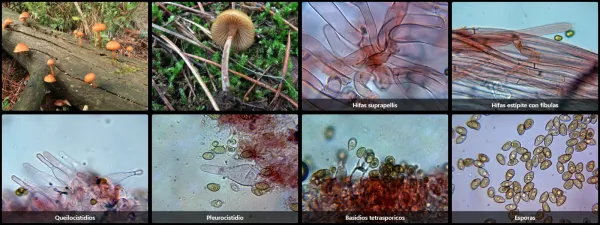
Galerina marginata
Taxonomy
Main synonym
Common names
Galerina marginada, galera hiltzaile.
Geographic references:
Interactive map with data from GBIF.




Morphological Features:
Pileus of notable size for the genus, some specimens reaching up to 4 cm in diameter. Initially hemispherical, soon becoming convex, and eventually adopting a flattened-convex shape; it rarely flattens completely. This species exhibits a certain degree of hygrophanicity, causing its color to vary from the usual ochre-buff to paler tones depending on the specimen's moisture content. Additionally, the smooth or barely striate margin may become more distinctly striate due to transparency when dry.
Lamellae adnate and sinuate, yellowish-ochre in color, evolving to rusty-brown tones with spore maturation. When young, they are more crowded but tend to become distant in mature specimens.
Stipe well-proportioned, similar in color to the pileus, especially when young, becoming dark brown from the base upwards. It is somewhat fibrillose and tends to become hollow with age. It bears a distinct membranous ring in younger specimens, which often becomes appressed or disappears.
Flesh thin, yellowish-ochre in color except at the stipe base where it is practically brown. It has a farinaceous odor that intensifies when the mushroom is rubbed, and a similarly farinaceous taste.
Habitat:
This species has long been considered exclusive to conifers, a view we judge to be incorrect. In fact, although we have frequently observed it in that habitat, we present here specimens collected on beech. Its ecology is generally lignicolous, though it may occasionally appear near logs or stumps. It can fruit at various times of the year but predominantly in autumn, being relatively common.
Observations:
We present here a deadly poisonous fungus that must be recognized by enthusiasts, given that it contains amatoxins in significant quantities, causing poisoning similar to that of Amanita phalloides or "death cap". The taxonomic position of Galerina autumnalis is somewhat controversial; for some it is a synonym of Galerina marginata, while others separate it as an independent species. We believe the name has always been applied to forms of Galerina marginata with a habitat on or under broadleaf trees, as is the case with the specimen we present here.