
Galerina clavata
Taxonomy
Main synonym
Common names
Not available
Geographic references:
Interactive map with data from GBIF.
Morphological Features:
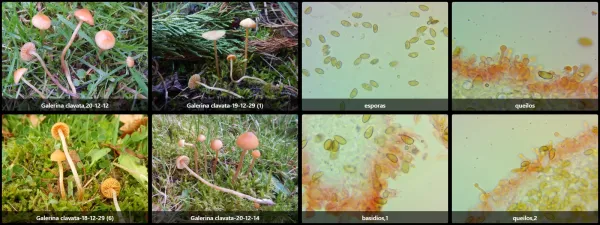
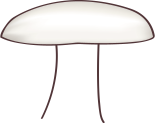
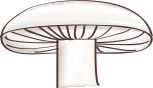
Pileus small in size, reaching barely 3 cm in diameter at full development, somewhat conic at first, then becoming hemispheric, and finally convex. Its surface is ochre-buff colored, with a reddish tone in the center fading towards the margin; it becomes shiny when wet but is not viscid. It is a hygrophanous species that is broadly striate, to the point where only a small central area remains unstriate.
Lamellae adnate to subfree, ochre-buff colored, paler than the pileus. They are broad, distant from each other, and interspersed with lamellulae; they are also wide and ventricose. Spore print ochre-ferruginous, staining them only faintly.
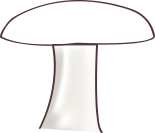
Stipe practically glabrous, ochraceous to honey-colored, disproportionately elongated relative to the pileus, cylindrical, and usually curved. It is quite fragile.
Flesh scant, insignificant, somewhat fibrous in the stipe, but not excessively so. Odor insignificant and taste of rancid flour.
Habitat:
A species associated with certain bryophytes, commonly known as mosses, thus fruiting in damp, grassy, and mossy places. Its preferred season of appearance is autumn, but its presence in other seasons cannot be ruled out. Despite not being heavily referenced in the literature, we consider it a common species.
Observations:
We classify it as having no culinary value, given the lack of toxicological studies on it; however, it should not be trusted, as related species, such as Galerina marginata, are deadly poisonous. It is known, however, to contain anti-tumor polysaccharides, which have so far only been tested in laboratory mice and have shown efficacy against various sarcomas.