
Fuscoporia contigua
Taxonomy
Main synonym
Common names
Not available
Geographic references:
Interactive map with data from GBIF.
Morphological Features:
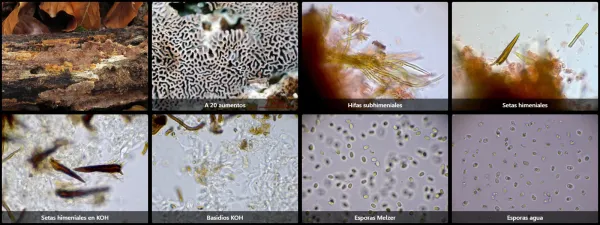
Basidiocarp resupinate and perennial, forming crusts of variable dimensions attached to wood. On a suede-colored mycelium, ochre fruiting bodies develop, adopting the contour of the substrate wood. They commonly exhibit a darker, brownish margin or active growth zone, with the central area being thicker and more cushioned, while the margins are thinner.
Hymenium composed of several annually superimposed layers of pores, as the species is perennial. The pores are small, numbering at most 3 per millimeter, and range from dark ochre to brown with a cinnamon tint. They are rounded but occasionally somewhat irregular.
Stipe absent; attaches directly to the substrate.
Flesh or context light-colored, with a hard, corky consistency resembling the substrate wood, lacking any distinct odor.
Habitat:
The photographed specimens were found on degraded wood of Rosa canina, a wild rose commonly known as dog rose, in January. This species can also be found on dead wood of various broadleaf trees throughout the year. It is poorly documented in the literature, indicating that it is a very rare species.
Observations:
It is a wood-decaying fungus that causes white rot. It can be easily confused with numerous other species, necessitating thorough analysis for accurate determination. Fuscoporia ferruginosa is practically identical and shares a habitat on hawthorn wood, wild roses, and broadleaf trees; macroscopic differences are minimal. If anything, the latter exhibits a much lighter growth zone that contrasts with the remainder of the basidiocarp, and its pores are smaller, numbering 5 to 6 per mm. Donkioporia expansa is also very similar, but thicker and occurring in a different habitat.