Fuligo septica
Taxonomy
Main synonym
Common names
Not available
Geographic references:
Interactive map with data from GBIF.





Morphological Features:
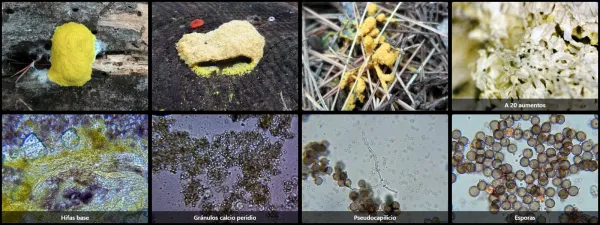
Plasmodium is amoeboid, white or yellow in color, formed after multiple cell divisions. It is creeping and exhibits reversible cytoplasmic streaming, capable of moving across the substrate by phagocytosing bacteria and small organisms while growing. Under conditions of high humidity, flagellated cells are formed. During its movement, it leaves behind a trail called a hypothallus, which is white in color and often clearly visible when this striking species is encountered in the field. This form of plasmodium with granular protoplasm is termed a phaneroplasmic plasmodium, and under appropriate conditions it fruitifies, giving rise to reproductive bodies known as aethalia.
Aethalia consist of a bright yellow mucilaginous mass. They may rise 2 to 3 cm above the substrate and spread laterally for several additional centimeters, never adopting a definite shape but rather conforming to the contours of the underlying substrate. Upon maturation, this mass hardens considerably and turns ochraceous; rupture of the enclosing membranous peridium releases the spores as a powdery mass. Spore dispersal is associated with a columella embedded within the capillitium, which bears calcium carbonate nodules.
Habitat:
It is a fairly common species in our forests, fruitifying in spring and throughout autumn. It grows on dead wood, leaf litter, pine needles, and even on grass, showing no preference for any specific forest type.
Observations:
A species of the so-called Myxomycetes, characterized by its formless mucilaginous mass appearance, bright yellow coloration, and expansion conforming to the substrate upon which it rests. It is frequently confused with another myxomycete, Leocarpus fragilis, when the latter exhibits a yellow coloration; however, close examination will prevent misidentification, as the latter is not composed of a mucilaginous mass but rather consists of clustered carpophores. Aside from this, it is a practically unmistakable species.