
Fuligo cinerea
Taxonomy
Main synonym
Common names
Not available
Geographic references:
Interactive map with data from GBIF.





Morphological Features:
Plasmodium with granular protoplasm and reversible rhythmic cytoplasmic streaming, formed through multiple cellular divisions of zygotes. Depending on humidity conditions, these cells are amoeboid (myxamoebae) or flagellated. It is white and creeping, leaving behind a mucous trail of the same color called a hypothallus during its movement. It feeds on small living organisms, such as bacteria. This type of plasmodium is termed a phaneroplasmodium, and is common in the order Physarales. When temperature and humidity conditions are suitable, fruiting of the reproductive bodies, called aethalia, occurs.
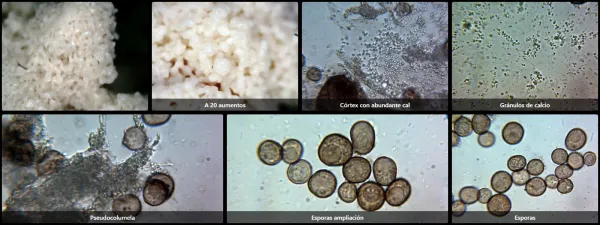
Aethalium formed by a mucilaginous mass of dirty white or grayish color, several centimeters in size and cushion-shaped. It is an amorphous mass that adapts to the shape of the substrate on which it fruits. Its macroscopic appearance resembles curdled milk, and its consistency is mucous; if pressed with fingers at this stage, it practically disappears. However, upon maturation, it darkens and hardens considerably, giving rise to a darkish peridium that opens to reveal a pseudocapillitium, which releases the spores housed inside the peridium through a columella.
Stipe absent; it adheres directly to the substrate.
Spores dark brown under the microscope, black spore print. They are of considerable size, reaching up to 15 micrometers, and are more or less spherical in shape.
Habitat:
This species appears mainly in late summer and throughout autumn, being relatively common. It fruits on dead wood, small twigs, or directly on grass.
Observations:
It is a Myxomycete species identified by its consistency and appearance resembling curdled milk, along with its whitish-gray color. When found on grass, it could be confused with Sebacina incrustans, which however has an appearance of clustered small eggs, and is moreover a Phragmobasidiomycete, not a Myxomycete. Another Myxomycete with similar ecology and grayish color is Mucilago crustacea, but with a very different consistency. Fuligo septica has a similar shape, but is yellow. The species discussed here sometimes adopts violet tones when parasitized by Nectriopsis violacea.