Fomitopsis pinicola
Taxonomy
Main synonym
Common names
Yesquero del pino, yesquero rebordeado.
Geographic references:
Interactive map with data from GBIF.




Morphological Features:
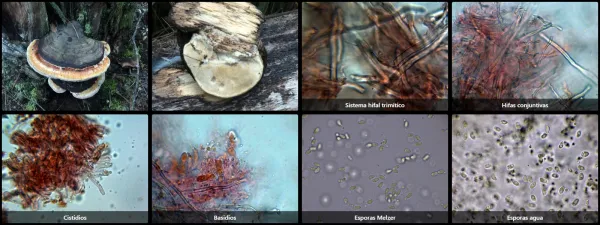
Basidiocarp perennial and of considerable size, can reach up to 50 cm in width, with a projection of 25 cm, and a thickness exceeding 10 cm. It generally has a semicircular or bracket-shaped form, and is so firmly attached to the substrate on which it fruits that it is difficult to detach. Initially reddish-brown in color, although its surface typically displays concentric zones of varying shades, grayish or markedly ochre. Older specimens develop a dark brown to blackish surface, which is covered by a highly characteristic varnish-like substance. The margin or growth zone is yellowish-white, bluntly edged.
Hymenium composed of annual layers of tubes arranged in strata without an evident separating layer, whitish or yellowish in color. Pores are concolorous, small in size, 3 to 5 per mm; the hymenial surface stains upon rubbing.
Stipe absent; attached directly to the substrate.
Flesh hard and leathery, corky in consistency and cream-colored, darker with age. Its odor and taste, perhaps due to transfer from the substrate itself, are resinous. It is notably thick, especially at the point of attachment to the substrate.
Habitat:
It is a frequent species on pine wood, but not so on other types of trees, fruiting practically year-round on wounds, or directly on dead trees.
Observations:
Given its habitat and reddish-brown color, we do not believe it is difficult to identify; however, there are wood-fruiting species that also possess that resinous or varnish-like layer on their surface, such as Ganoderma resinaceum, which is more common on oaks, whose resinous layer is denser, and which is also a softer species than the one described here. Ganoderma pfeifferi may show some similarity, although its flesh is much darker, brownish rather than cream-colored.