
Fomitopsis betulina
Taxonomy
Main synonym
Common names
Yesquero del abedul, urki-ardagai, bolet d'esca de bedoll.
Geographic references:
Interactive map with data from GBIF.
Morphological Features:
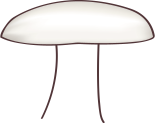
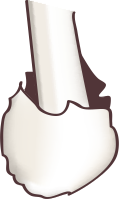
Basidiocarp annual, of notable size, may project from the substrate by more than 10 cm, capable of reaching 20 cm in width, and a thickness that can exceed 5 cm. It is typically reniform, though it sometimes assumes a semicircular or tongue-like shape. Its pileal surface is completely smooth, of uniform ochraceous-grey color, distinctly ochre when old; under drought conditions it tends to crack, and the area near the margin is frequently paler. A consistently rounded margin is characteristic of this species.
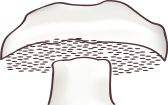
Hymenium composed of white tubes up to 8 mm long and equally white pores, slightly darker when old, more or less rounded, measuring approximately 3 to 4 per mm. An unusual feature for the genus is that in mature specimens, these can be separated from the flesh.
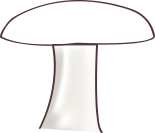
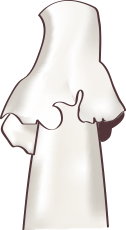
Stipe rudimentary and lateral, the same color as the pileus, sometimes buried in the substrate and not visible.
Flesh whitish, relatively soft in the early stages of development, hardens rapidly to a cork-like consistency. Its odor is perceptible but not unpleasant, and its taste is somewhat bitter.
Habitat:
This is a species that exclusively parasitizes birch wood, causing brown rot. It fruits practically year-round, being a frequent and abundant species in its exclusive habitat.
Observations:
In general, wood-inhabiting fungi are not easy to identify; however, this is an exception. Its peculiar shape and exclusive habitat under birch trees make it readily identifiable. This species is often itself parasitized by a fungus named Trichoderma pulvinatum, which we also describe in this work.