
Fomes fomentarius
Taxonomy
Main synonym
Common names
Yesquero, supizteko ardagai, casco de caballo, bolet désca.
Geographic references:
Interactive map with data from GBIF.




Morphological Features:
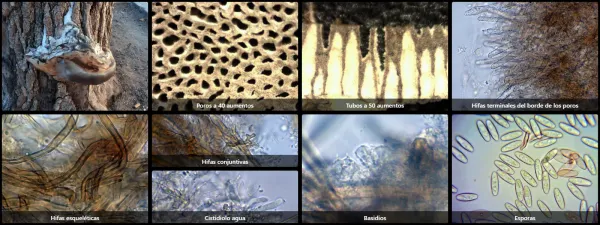
Basidiocarp perennial and large-sized, reaching up to approximately 50 cm in width. It attaches to the substrate along its entire width and projects outward by roughly half that width, attaining a thickness of nearly 20 cm near the point of attachment. Horse-hoof shaped, though it may sometimes become somewhat deformed, appearing as a mere woody conk attached to the wood. The surface is very dry and gray with varying shades; it lacks a varnished appearance, though it typically exhibits ridges. The margin is generally lighter, sometimes yellowish.
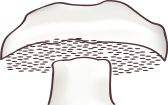
Hymenium composed of elongated tubes with a ferruginous-ochre coloration, and very small pores, up to 5 per mm, rounded. Initially light gray, tending toward ochre with age. As the fungus is perennial, the tubes are arranged in annual strata.
Stipe absent; this is a sessile species attached to the substrate along its entire width.
Flesh corky-textured, somewhat less hard when young, but eventually resembling the wood upon which it fruits. Brown in color with yellowish to tawny hues. Odor is mild and indistinct; taste is unpleasant.
Habitat:
A wood-decay fungus that causes white rot, thus fruiting on trees in advanced decline or already dead, typically broadleaf species. Common on poplars and can be found throughout the year.
Observations:
This is a species that is relatively easy to identify, characterized by its attachment to the substrate wood along the entire width of the basidiocarp, its horse-hoof shape, and its small rounded pores. It bears some resemblance to Phellinus igniarius, which is darker/blackish and has different microscopic features, as well as to Ganoderma applanatum, which completely lacks the characteristic hoof shape of this species.