Faerberia carbonaria
Taxonomy
Main synonym
Common names
Embudo de los quemados
Geographic references:
Interactive map with data from GBIF.




Morphological Features:
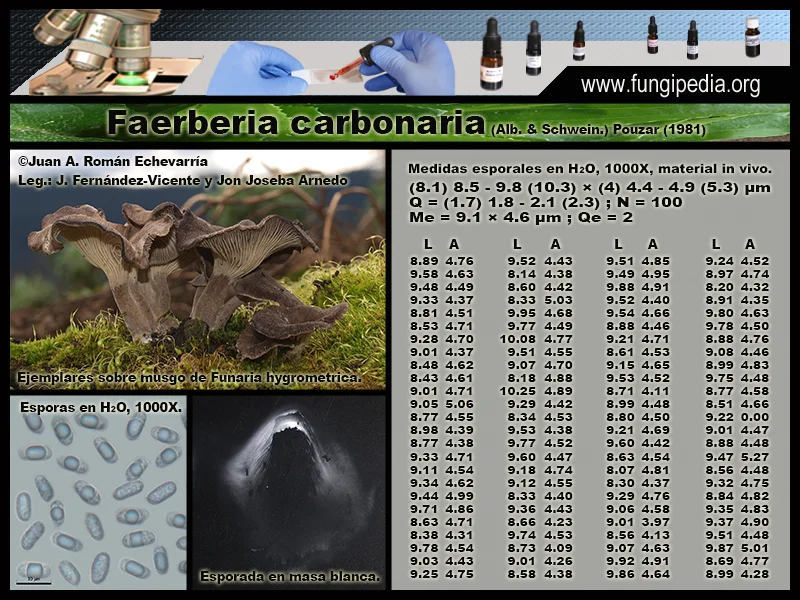
Pileus of considerable size, with adult specimens ranging from 3 to 7 cm in diameter. It exhibits a characteristic shape reminiscent of species in the genus Cantharellus, to which it was formerly related, being infundibuliform or funnel-shaped, with a depressed center and a margin that transitions from deeply incurved in youth to thin and undulate upon maturation. The cuticle, soft to the touch and slightly felted, is quite fibrillose and varies in color from specimen to specimen depending on hydration and maturity, ranging from nearly black to brownish-black tones, with a tendency to fade to grayish-brown upon drying.
Lamellae crowded, initially whitish, becoming somewhat grayish with age. They are strongly decurrent on the stipe and resemble the ridges of Cantharellus. Typically irregularly forked and broadly anastomosing, they may occasionally and somewhat randomly become intervenose.
Stipe variable in size depending on the substrate, generally proportional to the pileal diameter. It may be central or eccentric, solid, and similar in color to the pileus or somewhat more grayish, being more or less cylindrical to slightly compressed.
Flesh distinctly scant, whitish to gray in color. It has a somewhat elastic yet soft consistency when bitten, is completely tasteless when raw, and lacks any appreciable or definable odor.
Habitat:
The specific epithet carbonaria clearly indicates the habitat in which it fruits. This is a species that emerges on burned ground, areas previously affected by fire, and contributes to some extent to the regeneration of such sites. It typically appears in more or less numerous groups or cespitose clusters; isolated specimens are rare. It does not have a preferred fruiting season, as it can be found in autumn, spring, or even winter. The specimens collected for this profile were located in Zeberio (Bizkaia), in an area devastated by fire and subsequently logged, during March and April, courtesy of Javier Fernández Vicente and Jon Joseba Arnedo.
Observations:
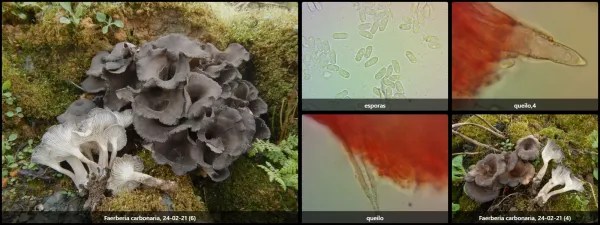
This species has been classified under numerous different genera, including Merulius, Lentinus, Geopetallum, and Cantharellus, before being transferred to Faerberia in 1981. It was indeed placed in Cantharellus for a long time, despite microscopic and genetic differences distinguishing it from that genus. It is characterized by its dark, funnel-shaped pileus, dark anastomosing lamellae, and occurrence on burned ground. Macroscopically, it resembles Cantharellus cinereus, a smaller species typical of broadleaf forests that possesses a characteristic plum-like odor absent in this species. Microscopically, it exhibits features from various genera: a dimitic hyphal system as seen in Aphyllophorales, and metuloid cystidia similar to those in Hohenbuehelia. Consequently, a new genus was established for it due to its taxonomic complexity.
Microscopy of Faerberia carbonaria