

Entoloma porphyrophaeum
Taxonomy
Main synonym
Common names
Not available
Geographic references:
Interactive map with data from GBIF.




Morphological Features:
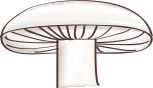
Pileus that can reach notable dimensions, often exceeding 10 cm in diameter, although it is most commonly found between 5 and 10 cm. It is conical in youth but gradually flattens out, retaining a well-differentiated umbo at the center. It is radially fibrillose and brownish-purple or lilaceous in color; all located specimens exhibited a distinctly purple margin. This margin is involute in young individuals, later becoming thin and regular; furthermore, as it is not a hygrophanous fungus, it is not striate.
Lamellae sinuate to free, relatively distant, with intervening lamellulae. They are pale in youth, whitish, but turn pink with sporulation, and finally become very dark salmon, almost brown. Margins irregular.
Stipe elongated and cylindrical, sometimes slightly thickened in the central portion, with a whitish background but entirely covered by longitudinal brownish-purple fibrils. It is solid and approximately 2 cm in diameter in adult individuals.
Flesh firm and of acceptable thickness, white throughout all parts, except for the subcuticular surface which is concolorous with the pileus. It has a rather unpleasant taste, although its odor is mild.
Habitat:
Our collection was made in a meadow or grassland area barely used or abandoned for such purposes. We found numerous specimens growing in groups, approximately 20 in number, at various stages of development, all with a purple margin. This species is also reported from woodland clearings, and although we found it in autumn, it may also appear during spring. It is rare, or at least uncommon.
Observations:
This species is characterized by its notable stature, its resemblance to a Tricholoma, and the brownish-purple coloration of the entire basidiome except for the lamellae. Entoloma jubatum, which has a less robust stature and a browner coloration, may bear some resemblance to this species. We classify it as having no culinary value due to this aspect being still poorly studied, but it is suspected to be toxic.