
Entoloma opacum
Taxonomy
Main synonym
Common names
Entoloma opaco
Geographic references:
Interactive map with data from GBIF.





Morphological Features:
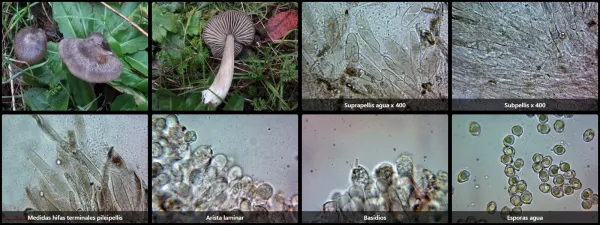
Pileus with a diameter ranging from 2 to 4 (5) cm; its shape evolves from nearly conic at birth, becoming convex and obtusely umbonate, then plane and similarly umbonate, and finally late-expanded and somewhat depressed. Cuticle strongly glabrescent and radially fibrillose, sometimes even rugulose, with a barely perceptible brown background, the grayish tone of the fibrils predominating; very dark, almost black in young specimens, and ash-gray in mature ones, with irregular darker patches. Margin slightly involute when young, later expanded and somewhat undulate; not striate as the species is not hygrophanous.
Lamellae shortly sinuate or emarginate; the sinus occurs very close to the stipe, sometimes simulating attachment via a small tooth. Moderately spaced, grayish in color, evolving to dark pink tones upon sporulation. Fertil edge concolorous and irregular, sometimes even slightly crenulate.
Stipe proportionate to the pileus size, cream-colored at base but overlaid with grayish fibrils, cylindrical, straight or slightly curved, finely longitudinally striate, sometimes appearing twisted due to the arrangement of these striae, solid to fistulose.
Flesh scant, grayish to ochre in color, poorly consistent and somewhat fibrous, with a very faint fungal odor and a not unpleasant taste reminiscent of iron-rich water, turning farinaceous late.
Habitat:
This species exhibits a clear meadow-dwelling tendency; it is referenced in habitats such as grasslands and gardens with various tree presences. Our collection was made in herbaceous areas, specifically on fixed coastal dunes in Gorliz, Bizkaia. Approximately 10 specimens were found in a line near a Pinus pinea, while scattered individuals were located at other sites lacking this tree.
Observations:
Entoloma opacum is a rare species native to central Europe that has been expanding southward in recent years. Several collections of this species have been recorded in eastern France, and some also in Italy. In the Iberian Peninsula, it was published in Revista Catalana de Micologia, vol. 35: 43-48; 2013, but we understand that this record was based on an Italian collection; therefore, to our knowledge, it has not yet been collected and published from the peninsula itself. At first glance, it may resemble gray Tricholoma species due to its general appearance, but its spore print is pinkish. However, it is very difficult to separate it from other Entoloma species, particularly those of section Erophila, to which it belongs. The holotype of this section, Entoloma plebejum=Entoloma erophilum, is very similar; it differs microscopically by the presence of cheilocystidia, which are absent in the species described here, and by having longer spores.
Microscopy of Entoloma opacum