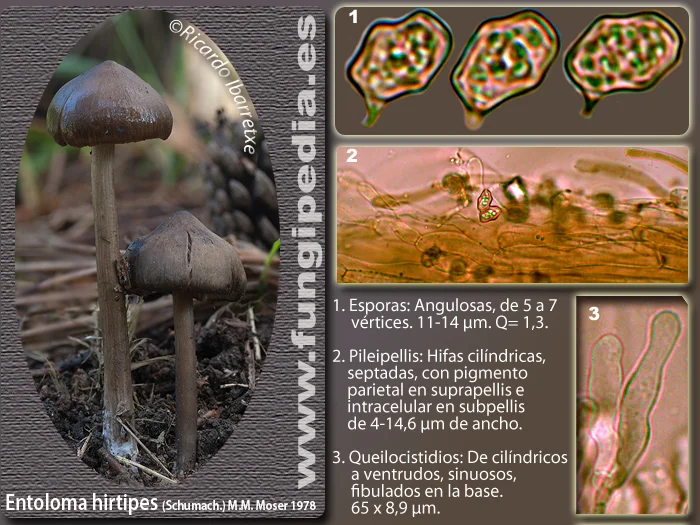

Entoloma hirtipes
Taxonomy
Main synonym
Common names
Entoloma de pie velloso, chivata del Marzuelo.
Geographic references:
Interactive map with data from GBIF.
Morphological Features:
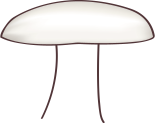
Pileus with a diameter ranging from 3 to 6 (8) cm in adult specimens, conico-campanulate in early stages, gradually expanding to become first convex and umbonate, and finally nearly flat, but retaining a well-defined umbo in the central zone. It is a hygrophanous fungus, which results in some color variability depending on its degree of hydration; it ranges from dark brown in highly hydrated specimens to pale grey upon drying, sometimes exhibiting olivaceous tinges. Its cuticle is typically radially fibrillose and glossy when wet, with a fairly regular margin that appears striate by transparency.
Lamellae adnate to subfree, pale greyish in color, with numerous lamellulae; spore deposition during sporulation stains them a dirty pink.
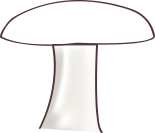
Stipe cylindrical and elongated, ochre or occasionally somewhat greyish, fistulose and noticeably longitudinally grooved, pruinose in patches, particularly in the upper region. It typically exhibits white rhizomorphs at the mycelial attachment, and the base is covered with a whitish tomentum that tends to extend over the entire lower third of the stipe with age.
Flesh scant and thin, ochre in color; its odor has a farinaceous component but is unpleasant rather than pleasant, being rancid, and its taste can be described as analogous to the smell.
Habitat:
This species has been located during spring beneath mountain conifers, at altitudes above 1000 m a.s.l., where an abundant number of specimens were found, leading us to conclude that it is an abundant species in its specific habitat. In autumn, it may be found more sparsely beneath broadleaf trees as well.
Observations:
In certain regions of our geography, this toxic species is known as the "chivata" of Hygrophorus marzuolus, given that they often share habitat and fruiting season. Entoloma species of section Nolanea are very similar to one another; this species is characterized by its habitat beneath mountain conifers, a whitish stipe base, and dirty pink lamellae at maturity. Entoloma hebes is a more autumnal, heliophilous species found in non-mountainous areas and possesses smaller spores. Entoloma vernum, also a spring species, is reported beneath Juniperus sp. and Lawson cypress (Chamaecyparis lawsoniana); its odor is herbaceous and it lacks cheilocystidia, whereas the species described here possesses a rancid farinaceous odor and does bear cheilocystidia.
Microscopy of Entoloma hirtipes