Entoloma conferendum
Taxonomy
Main synonym
Common names
Entoloma de esporas cruciformes.
Geographic references:
Interactive map with data from GBIF.




Morphological Features:
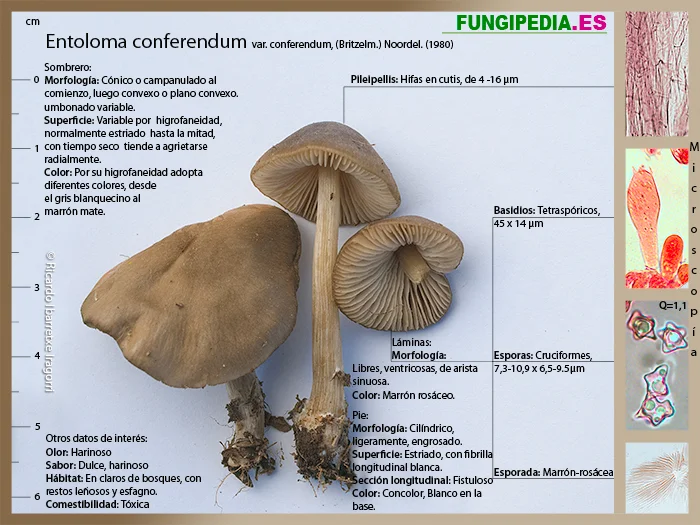
Pileus measuring approximately 5 cm in diameter at maturity; its shape evolves from conical to campanulate, then hemispherical, ultimately becoming plano-convex, with a central umbo being common. Color is highly variable as this is a markedly hygrophanous species; depending on its moisture content, it exhibits shades ranging from gray to various ochre tones, with the center generally remaining darker due to prolonged moisture retention. Cuticle is fibrillose or squamulose, and the margin is striate, sometimes extending to half the pileus radius.
Lamellae are subfree, initially cream-colored, evolving to pale pink, and finally strong pink, almost ochraceous. They are quite broad with some lamellulae, and the edge is typically somewhat crenulate.
Stipe is elongated, initially fistulose and later hollow, similar in color to the pileus but longitudinally striate and covered with silvery fibers. A whitish tomentum is commonly present at the base.
Flesh is thin and somewhat soft, slightly firmer in the pileus and brittle in the stipe. Both odor and taste are farinaceous, more or less pronounced depending on the specimen's hydration level.
Habitat:
The host tree under which it fruits is not particularly relevant, as it is a rather heliophilous species that also fruits in meadows and mountain grasslands. It favors moist substrates and can be found from spring onwards, when it is most frequent, becoming rarer in autumn.
Observations:
This is a cosmopolitan species, giving rise to numerous varieties and ecological forms. We highlight var. pusillum, which is very small and generally fruits on wood rather than soil; var. rickenii is intermediate in size between the two and lacks the characteristic farinaceous odor of the type species. This species is easily distinguished under the microscope by its cruciform spores, although it may bear some resemblance to Entoloma rhombisporum, which has rhomboid spores and a more yellowish tint.
Microscopy of Entoloma conferendum