Entoloma cetratum
Taxonomy
Main synonym
Common names
Not available
Geographic references:
Interactive map with data from GBIF.




Morphological Features:
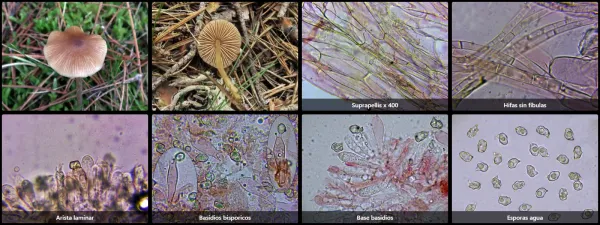
Pileus rather small, at full maturity it may approach 5 cm in diameter, but typically does not exceed this. When emerging, it is conical, gradually expanding to become plano-convex, retaining a central umbo that is not overly acute. It is ochre in color, but as a hygrophanous species, depending on the moisture level, it exhibits reddish or duller tones, even yellowish, especially towards the margin. It is translucently radially striate, and the margin is regular, scarcely undulate.
Lamellae adnate, whitish when young, becoming ochraceous prior to spore discharge, and finally adopting the pinkish color of the spores. They are irregularly arranged and not too crowded.
Stipe elongated, honey-ochre in color, covered with a pruina that sometimes gives it a grayish appearance. It is cylindrical, but may occasionally be laterally compressed, fistulose, and bearing a whitish tomentum at the base.
Flesh somewhat soft, ochraceous in color, with a pleasant fungal odor bearing a faint farinaceous note, and a mild taste.
Habitat:
A species typical of humid coniferous forests and peatlands; in the case of our specimens, found under Pinus sylvestris. The photographs were taken in May, but it also fruits during autumn, not being exclusive to spring as is the case with other Entolomas. It is not a particularly common species, although it may be locally frequent.
Observations:
We consider it without culinary value due to limited study of this aspect, although there are suspicions that it may be somewhat toxic. It can be macroscopically confused with many other Entoloma species, such as Entoloma conferendum, which is generally more conical, or Entoloma formosum, which is less umbonate; however, to confirm identification of the described species, microscopic analysis is required, wherein its bispored or monospored basidia can be observed.