
Elaphomyces muricatus
Taxonomy
Main synonym
Common names
Trufa de ciervo espinosa
Geographic references:
Interactive map with data from GBIF.
Morphological Features:
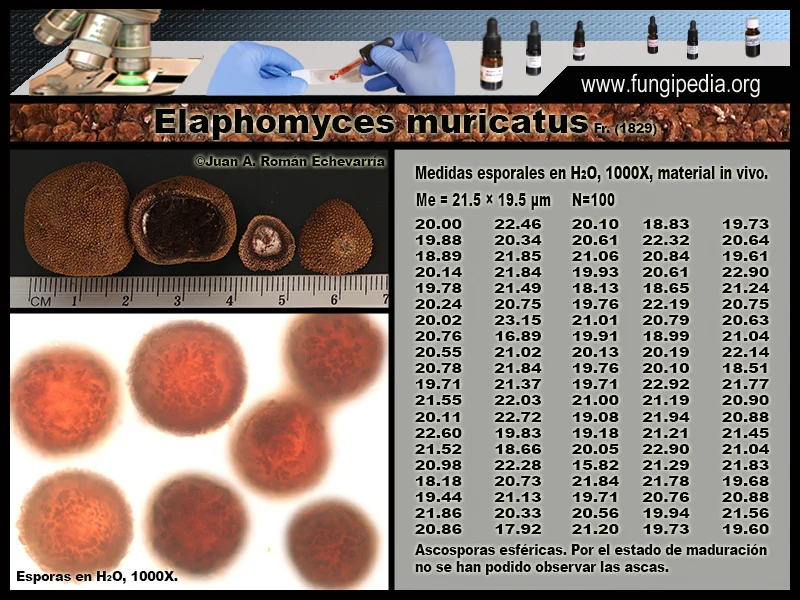
Fruit body with a generally dry and hard appearance and a prominent spiny surface, exhibiting the tuberous or small potato-like shape typical of hypogeous fungi. It may sometimes become globose, but is normally subglobose; it can also be somewhat compressed, yet remains generally quite regular without excessive protrusions or deformities. The diameter of mature specimens ranges from 1 to 4 cm, and its color is highly variable, ranging from an initial yellowish-ochre to distinctly brown tones, with weathered ferruginous shades sometimes appearing. The external presence of whitish to ochraceous mycelial remnants forming a crust is frequent.
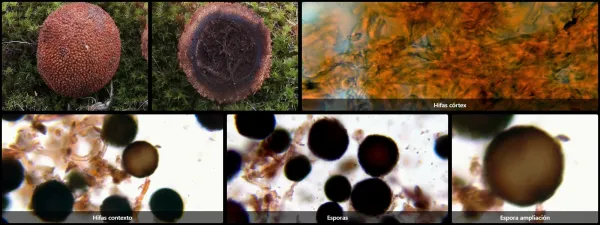
Peridium composed of two perfectly differentiated parts when sectioned: an exoperidium formed by evident pyramidal warts ranging from yellowish-ochre to brown, which can be slightly over half a millimeter high and are composed of interwoven hyphae; and an endoperidium that can easily exceed 2 mm, exhibiting a marbled appearance with a whitish background and venation. Within the endoperidium, two zones are also differentiated: an outer zone retaining the whitish tone, and an inner zone adjacent to the gleba, present in all collected specimens, displaying a dark brown or lilaceous hue. The entire peridium as a whole is quite thick, potentially reaching 3 mm in thickness, which is otherwise typical for the genus Elaphomyces.
Gleba compact in young specimens, pinkish-whitish or slightly grayish in color, maturing into a pulverulent brown or dark brown mass. It constitutes the fertile part of the fruit body and houses subglobose or pyriform asci along with thick-walled, ornamented globose spores; all of these features can be observed in our microscopic characteristics section.
Flesh which is essentially the gleba itself, initially compact but disintegrating upon maturation. It possesses a characteristic odor reminiscent of gas, initially faint but becoming quite unpleasant as it matures.
Habitat:
This is a hypogeous species that typically fruits buried at a shallow depth, rarely emerging significantly to the surface. Its presence is often betrayed by foraging forest animals and by the parasitic fungus Tolypocladium ophioglossoides, which commonly attacks this species and whose fruit bodies do emerge above ground. It is commonly found under various deciduous trees such as chestnut, beech, or oak, and more rarely under conifers, potentially appearing practically year-round if conditions are favorable. Our collection was made in Laudio/Llodio (Álava), fruiting in this instance under American oak (Quercus rubra).
Observations:
Hypogeous species characterized by a peridium ornamented with spines or pyramidal warts, a dark brown or violet line in the peridium upon sectioning, and its equally ornamented spores featuring quite regularly arranged warts. The distinctive features of its peridium allow it to be relatively easily distinguished from Elaphomyces granulatus and Elaphomyces asperulus, which possess a smooth peridium. The species with which it shares the greatest similarity and is more difficult to separate from is Elaphomyces decipiens, characterized by more flattened scales on the peridium, more irregular spore ornamentation with curved warts or spines, and larger spores. Elaphomyces reticulatus is considered a form of Elaphomyces muricatus and is therefore synonymized with it.
Microscopy of Elaphomyces muricatus