
Elaphomyces granulatus
Taxonomy
Main synonym
Common names
Criadilla de ciervo, basahuntz-boilur.
Geographic references:
Interactive map with data from GBIF.

Morphological Features:
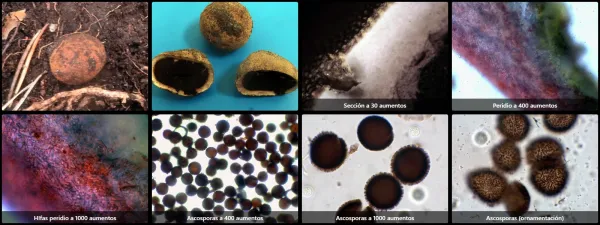
Basidiocarp 2 to 4 cm in diameter, somewhat irregularly globose in shape, occasionally ovoid and at other times simply spherical. The outer surface is granular due to the presence of small wart-like tubercles, and its color varies depending on specimen maturity; initially yellowish-ochre, even straw-colored when young, it eventually darkens with time, becoming practically brown.
Peridium visible upon sectioning the fruit body, a couple of mm thick, smooth, lacking veins, pale in color, almost whitish, sometimes tinged flesh-colored.
Gleba powdery and dark brownish to blackish upon spore maturation.
Flesh compact when young; eventually the inner zone disappears, leaving only the outer cortex. Initially its odor is faint, but upon maturation it becomes unpleasant, as does its taste, which turns somewhat bitter.
Habitat:
This is a hypogeous fungus, though it usually occurs very close to the surface. It fruits in late summer and early autumn, preferably among conifers, though also under beech trees, a habitat in which it has been photographed by us. It should be considered frequent.
Observations:
The common name "deer truffles" stems from the fact that forest animals habitually feed on this seasonal delicacy, which is otherwise inedible to humans. The odor attracts them and they unearth the fruit bodies to consume them, but this behavior is exhibited by various animals, not just deer. This species is frequently parasitized by both Tolypocladium capitatum and Tolypocladium ophioglossoides, which often betray its buried presence. It is easily confused with Elaphomyces muricatus, which has an almost identical appearance but whose endoperidium is veined.