
Elaphomyces cyanosporus
Taxonomy
Main synonym
Common names
trufa de ciervo de esporas azules
Geographic references:
Interactive map with data from GBIF.
Morphological Features:
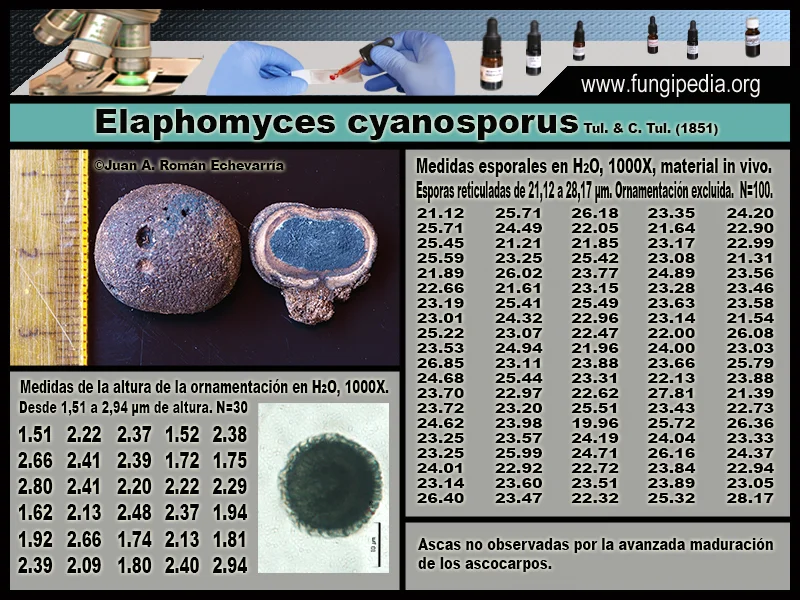
Fruitbody presenting the typical form of a small tuber characteristic of hypogeous species, sometimes globose, but more commonly oblong or flattened, fairly regular, with minimal protuberances, slightly protruding towards the base, though without forming a true cone nor a basal cavity. Its size is small; most specimens range between 0.5 and 2 cm in diameter, occasionally slightly larger, up to 3 cm. It has a dark coloration, ranging from dark brown to practically black, with bluish or blue-grey mycelial remnants frequently found at the base. The overall appearance of specimens of this species suggests a hard and tough fungus with a warty aspect.
Peridium thick, a fairly common characteristic in the genus Elaphomyces, capable of reaching or even slightly exceeding 3 mm. The exoperidium is hard and markedly warty, dark brown to nearly black in color, covered with warts that sometimes project upward into points while others are more flattened or rounded; near the base, they tend to disappear, making this area somewhat smoother. In cross-section, it reveals a whitish endoperidium, evident both near the gleba and adjacent to the exoperidium, with an intermediate brown or grey-brown zone visible.
Gleba constituting the fertile portion of the fruitbody; initially greyish-white with a bluish tinge, later distinctly blue. Upon maturity, it becomes a powdery mass dark blue to nearly black, containing globose, eight-spored asci and beautiful spherical blue spores that give the species its name. These spores are adorned with a fine reticulum that is sometimes incomplete; these characteristics can be observed in the "Microscopic Features" section of this profile.
Flesh hard and tough in the outer region, corky and inedible; practically absent in the gleba, which quickly turns to powder. Its odor, however, is quite pleasant, though much milder than that of truffles.
Habitat:
This is a species whose initial growth occurs hypogeously, underground, but it typically emerges to the surface as it matures, making its location feasible by sight ("visu"), although it is easier to locate using dogs. It usually grows solitary or more commonly in small groups, beneath or later upon the humus of broadleaf or mixed forests. It is understood that it can appear practically year-round if environmental temperature and humidity conditions are favorable. Our collection was autumnal; the specimens studied for this profile originate from the province of Álava and were located beneath Quercus robur.
Observations:
Macroscopically characterized by its dark, warty peridium and bluish gleba, and microscopically, among other features, by its beautiful spherical blue spores with ornamentation. Several species within the genus Elaphomyces share considerable similarities with the present one. Macroscopically, it may resemble the rare Elaphomyces maculatus, which however has brown spores, as well as Elaphomyces mutabilis, whose spores exhibit greenish or bluish tones but possess spinose ornamentation. Undoubtedly the most similar is Elaphomyces personii, a larger species that lacks the intermediate zone in the peridium upon sectioning, and whose spores are adorned with a broader reticulum than that of the species under discussion.
Microscopy of Elaphomyces cyanosporus