Disciotis venosa
Taxonomy
Main synonym
Common names
Peziza venosa, katilu zaintsu.
Geographic references:
Interactive map with data from GBIF.





Morphological Features:
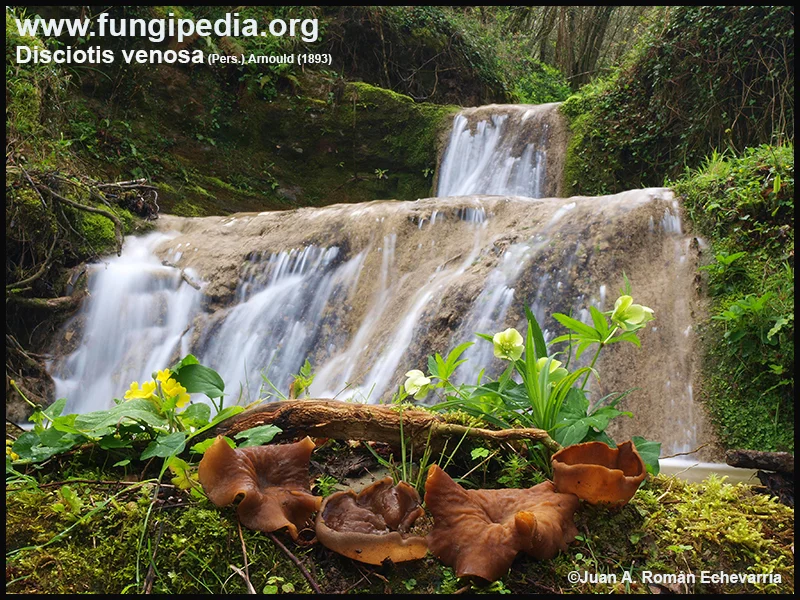
Carpophore cup-shaped and fairly open, which may almost flatten out when the specimen is old. Among cup-shaped Ascomycetes, it is undoubtedly the largest of all, with carpophores that can exceed 15 cm in diameter. The external surface is whitish, later turning pale ochre, and its appearance is markedly furfuraceous. The margin is incurved in young specimens, becoming irregularly undulate over time until it becomes lobed in mature specimens.
Hymenium practically smooth in very young specimens, but quickly developing folds; these gradually become more pronounced until the hymenium is provided with prominent venations. It has a more or less dark brown color.
Stipe thick and very short, generally embedded in the substrate, so the species appears sessile; indeed, the stipe is often absent.
Flesh very fragile and brittle in consistency, quite thin, with a marked chlorinated odor and a sweet taste that contrasts notably with that smell.
Habitat:
This is an exclusively spring species, sometimes early, potentially fruiting in late winter. It fruits along river and stream banks, invariably associated with the riparian trees that populate those areas. It is very common to find it alongside species of the genus Morchella, with which it shares season and habitat, and to which it is related. Where it occurs, it typically does so abundantly, often forming quite large groups.
Observations:
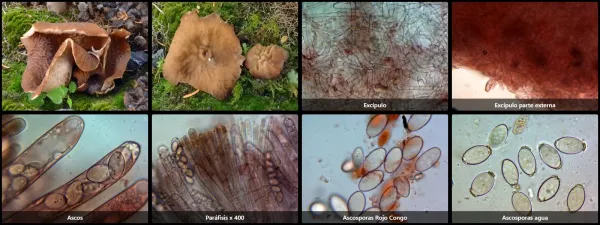
This is an edible species, as the chlorinated or bleach-like odor disappears upon cooking, which is necessary due to its potential toxicity when raw. Considering its habitat, spring appearance, and the prominent veins of its hymenium, identification is relatively straightforward; however, Discina ancilis bears a notable resemblance, but its habitat consists of coniferous forests, often appearing directly on wood. Microscopically, its smooth spores differentiate it from Discina species, which have finely verrucose spores.
Microscopy of Disciotis venosa