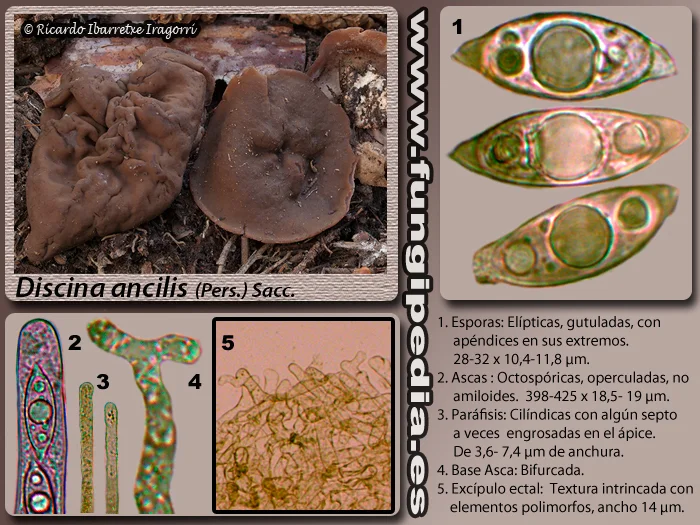

Discina ancilis
Taxonomy
Main synonym
Common names
Discina perlada.
Geographic references:
Interactive map with data from GBIF.

Morphological Features:
Carpophore that in the early stages of development is cup-shaped, but opens rapidly until it becomes expanded and irregularly undulate. Its size is highly variable; sometimes they do not develop much and remain at 3 to 4 cm in diameter, yet specimens over 10 cm in diameter can be found. The external surface is initially pale, whitish and pruinose, later evolving to ochraceous tones and becoming smooth. The margin, initially regular, becomes undulate in the same manner as the rest of the structure.
Hymenium located on the upper or internal surface of the ascocarp. This hymenial surface is quite uniformly reddish-brown and exhibits irregular protuberances or rugosities.
Stipe patent and evident but very short, merely 1 to 2 cm long with a wrinkled appearance; it usually shares the same color as the external surface, although it retains that whitish tone for a longer period.
Flesh relatively thick, whitish in color, somewhat elastic but ultimately brittle, with no noteworthy odor and practically tasteless.
Habitat:
This is a spring species that typically appears in more or less numerous groups, seemingly on the soil surface on many occasions, but actually growing on humus or buried woody debris from coniferous wood. Our specimens were specifically located under Pinus sylvestris. Despite its gregarious growth habit, it is not very frequent.
Observations:
This is a spring species associated with conifers, characterized by its reddish-brown hymenium bearing rugosities. Discina parma has a lighter color and fruits along riverbanks; Discina melaleuca, which is variable in color, also emerges under broadleaf trees. To differentiate these species microscopically, one must consider the different shapes of the spore appendages. Another species prone to confusion is Disciotis venosa, which has a veined hymenium and inhabits riparian forests.
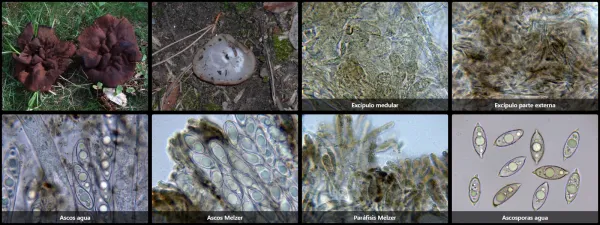
Microscopy of Discina ancilis