Descolea maculata
Taxonomy
Main synonym
Common names
Descolea de anillo dorado
Geographic references:
Interactive map with data from GBIF.




Morphological Features:
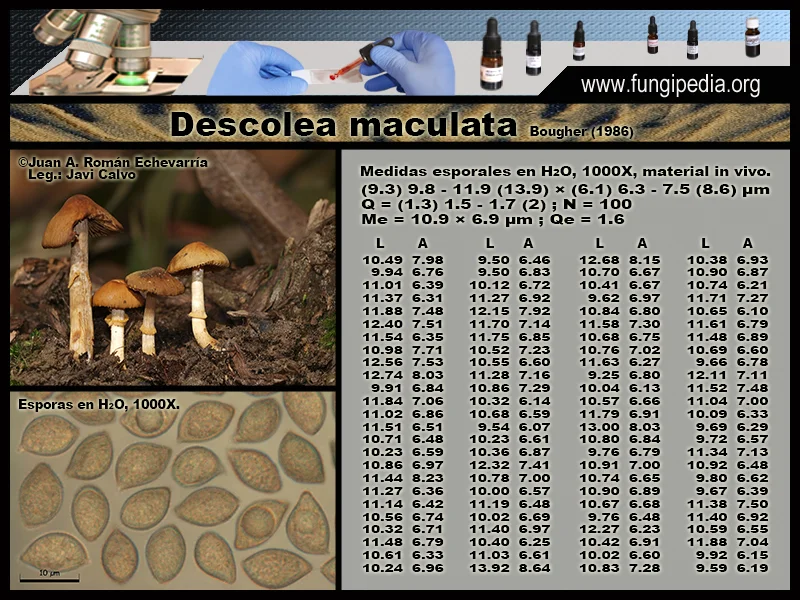
Pileus small in size; the diameter of adult specimens is usually variable, ranging from 1 to 4 cm. In early developmental stages, it is more or less conical, gradually opening to become convex and finally flattened, generally with an obtuse central umbo, lacking a pointed umbo. It is markedly hygrophanous, so its color varies depending on humidity, from dark brown in well-hydrated specimens to ochre or yellowish-ochre tones as it dries. It has a somewhat rugulose appearance and, especially when young, may retain some remnants of a yellowish veil. The margin is markedly striate.
Lamellae adnate and rather thick, especially in more developed specimens, with the presence of interspersed lamellulae. Their color is difficult to define precisely; when immature, they are light ochraceous with even a grayish tinge, maturing to a more yellowish or yellowish-ochre hue, sometimes with a ferruginous tinge. The gill edge is usually lighter in color than the rest.
Stipe cylindrical and elongated, sometimes exceeding 5 cm in length; rather slender. It may be straight but is more commonly found slightly incurved. Its color varies considerably, sometimes resembling that of the pileus and at other times much lighter, especially at the apex. It also bears yellowish-ochre fibrils. It possesses a membranous and persistent ring of a striking golden-yellow color, markedly striate, particularly on its upper surface. At the base, it may exhibit yellowish tones where it joins the mycelium.
Flesh rather scant and quite tough; it has a mild, insignificant odor, and its taste is slightly bitter.
Habitat:
This is a species of Australasian origin that has reached our region due to the massive planting of eucalypts that occurred some time ago in many areas of our geography. It is a species exclusive to this habitat, where it typically fruits, generally in moderately sized groups; it is rarely found isolated, and fruiting occurs primarily during the autumn months. The specimens studied for this profile were located in Galdakao, Bizkaia, within an Eucalyptus globulus plantation bordering a Quercus rubra stand, but mycorrhizally associated with the former, collected in November.
Observations:
Species of the genus Descolea are alien species introduced to Europe from Australia via eucalypt plantations, as is the case with other taxa such as Hydnangium, Descomyces, etc. This species is characterized, apart from its habitat, primarily by its macroscopic features: a beautiful, strikingly striate golden-yellow ring that is quite persistent. Microscopically, it is distinguished by asymmetric spores, which appear more convex on one side than the other in profile, and by cylindrical or occasionally clavate cystidia (see microscopic features). These characteristics readily distinguish it from Descolea tenuipes=Setchelliogaster tenuipes-Setchelliogaster rheophyllus, a species lacking a persistent ring and possessing lecythiform cystidia.
Microscopy of Descolea maculata