
Descolea alba
Taxonomy
Main synonym
Common names
Hipogeo blanco del eucalipto
Geographic references:
Interactive map with data from GBIF.

Morphological Features:
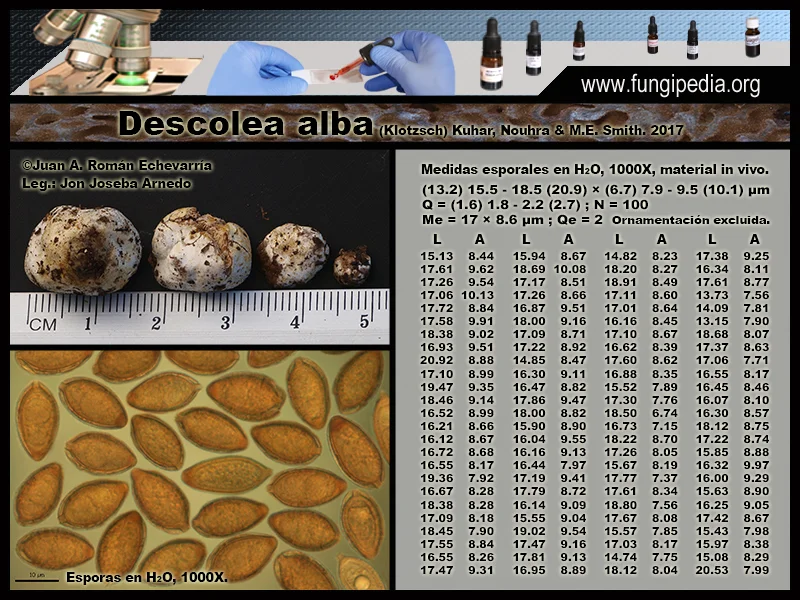
Basidiocarp of a certainly small size in our collection, with specimen diameters ranging between 0.5 and 2 cm, although collections of somewhat larger specimens have been referenced. It has a globose or subglobose shape, generally quite irregular, with some swelling, but without excessive protrusions or fissures as occurs in other semi-hypogeous species. The overall appearance is dry, with a not overly hard texture, and the external color is initially whitish or cream, staining yellowish or ochre in patches upon handling, and becoming brownish in old specimens upon drying.
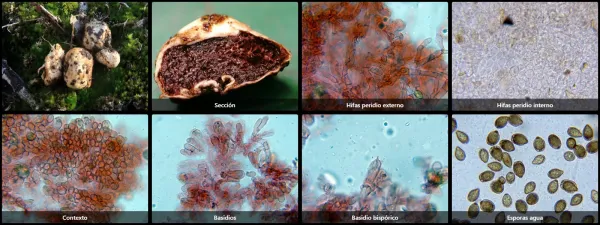
Peridium quite thin, generally smooth or somewhat tomentose, whitish-cream colored with yellowish or ochre spots, becoming ochre or brown and papery upon drying. It comprises two perfectly differentiated layers: an exoperidium composed of cylindrical hyphae with clamp connections, and an endoperidium containing globose cells (see microscopic features).
Gleba with a spongy appearance, composed of small alveoli or labyrinthine cavities. In young individuals, the color is white and the cavities are more compact; with maturation, the cavities gradually open up, and the gleba progressively acquires first a cream tone, then ochraceous, and finally a greyish-brown hue. It usually possesses some subtle sterile veins that are lighter in color than the surrounding tissue.
Flesh absent; this species lacks any characteristic odor or taste, both being weak or insignificant.
Habitat:
This is a non-native species that has reached our region through the planting of Eucalyptus carried out in the Cantabrian coastal area several years ago. It is exclusively associated with this specific habitat and typically fruits in late autumn, during winter, or early spring, usually in groups of several specimens. It is difficult to locate due to its small size and semi-hypogeous nature; it initially develops underground but protrudes above ground upon maturation. Despite this, it is a fairly common species in this specific habitat and prefers acidic soils. The specimens studied herein were provided by Jon Joseba Arnedo and collected in Akarlanda, Bizkaia.
Observations:
This species has a somewhat controversial taxonomic position, having been placed in various genera over time. Molecular analyses have established its placement in the genus Descolea, although some worldwide reference databases, as of the publication date of this entry, still list it under its former name, Descomyces albus. This species is characterized macroscopically by its whitish color with yellow or ochre spots, and microscopically by its distinctly differentiated double-layered peridium and the presence of clamp connections in its tissues. It bears considerable macroscopic resemblance to other related species such as Descolea albella or Descolea giachinii; however, they can be readily distinguished microscopically, as both lack globose cells in the inner peridium, with both layers being trichodermous.
Microscopy of Descolea alba