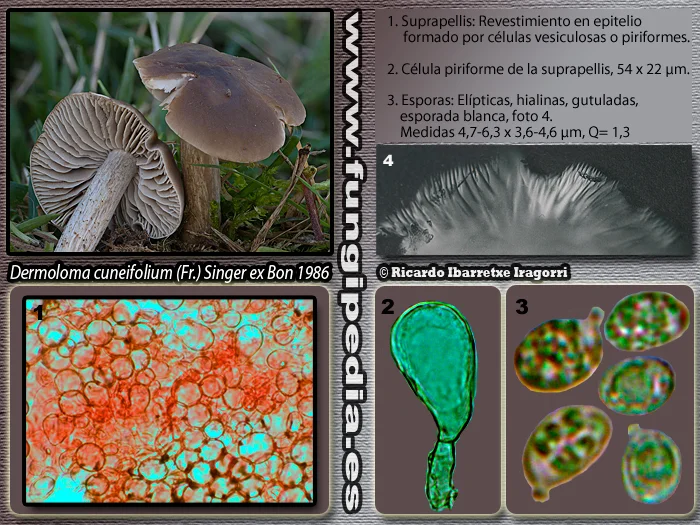
Dermoloma cuneifolium
Taxonomy
Main synonym
Common names
Not available
Geographic references:
Interactive map with data from GBIF.




Morphological Features:
Pileus small; adult specimens have a diameter that can approach 5 cm, in our case none exceeded this and most ranged between 2 and 4 cm. Initially bell-shaped or conico-bell-shaped, later opening to convex, and finally flattening out. The cuticle is brown, fairly uniform in young specimens, subsequently fading noticeably toward the margin while preserving a dark brown tone at the center; it is smooth and dry, only glossy when wet but never viscid. The margin tends to become undulate in many specimens upon flattening.
Lamellae notched before reaching the stipe and adnate by a tooth, very distant from each other, broadly ventricose and sinuous, whitish in some specimens and predominantly grayish.
Stipe proportionate in size to the pileus, fistulose from an early stage, fibrillose, cylindrical, whitish in color, and occasionally covered with ochraceous scales.
Flesh thin and somewhat soft, whitish or slightly grayish, easily brittle, with a very marked farinaceous odor reminiscent of Calocybe gambosa and an analogous taste.
Habitat:
This is a species with a clearly meadow-associated fruiting habit; our collection was made in a sheep-grazed pasture at low altitude in the province of Bizkaia (Spain). It generally grows in sparse groups forming rings or lines, and we observed it during December. It is considered a very rare species.
Observations:
This is a rather small species with an excellent odor and taste, but it contains a notable amount of muscarine in its composition. The appearance of this fungus closely resembles species of the genus Hygrocybe with which it shares habitat, particularly Hygrocybe nitrata=Hygrocybe murinacea, which has similar colors but a strong odor of bleach or ammonia. The most dangerous possible confusion is with Tricholoma terreum (negrilla), but the latter lacks such a markedly farinaceous odor and its pileus is mouse-gray and pilose.
Microscopy of Dermoloma cuneifolium