

Delicatula integrella
Taxonomy
Main synonym
Common names
Not available
Geographic references:
Interactive map with data from GBIF.



Morphological Features:
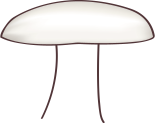
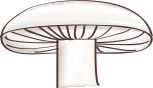
Pileus very small in size; at best, its diameter barely reaches 1 cm. Initially campanulate, it soon becomes convex and eventually flattens considerably, maintaining a well-defined umbilicate depression in the center throughout all these developmental stages. The cuticle is smooth, only velvety at emergence, white and translucent, allowing the hymenial zone to be seen through it. The margin is undulate in some specimens and more commonly crenulate.
Lamellae quite peculiar, translucent white in color, widely spaced and resembling folds rather than true gills. They are curved and decurrent, frequently bearing fine striations arranged perpendicularly to them.
Stipe rather elongated, sharing the same translucent whitish tone as the rest of the basidiome or even transparent, generally curved and with a slightly bulbous base.
Flesh insignificant; one might say it lacks true flesh. Its odor is practically absent, and its taste is mild and sweet.
Habitat:
A species that typically appears in small groups across a highly varied habitat; it can be found on mossy wood debris, various plant remains, or directly on soil humus. It is an uncommon mushroom, and combined with its small size, it proves difficult to locate. It may be encountered in both spring and autumn.
Observations:
This is a small-sized species characterized by its peculiar plicate lamellae. Its macroscopic appearance strongly resembles species of the genus Hemimycena, which, however, lack this type of lamellae and do not possess amyloid spores as is the case with the species described here. Some small white Mycena species such as Mycena tenerrima or Phloeomana alba may also be confused with it, although none of them possess plicate lamellae.