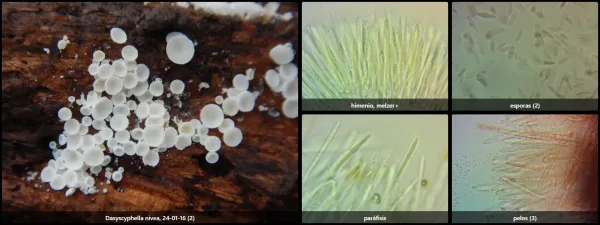
Dasyscyphella nivea
Taxonomy
Main synonym
Common names
Not available
Geographic references:
Interactive map with data from GBIF.




Morphological Features:
Carpophore composed of minute fruiting bodies; to give an idea of scale, a specimen measuring 3 mm would be considered exceptionally large. When young, they are cup-shaped with an inrolled margin, but eventually flatten considerably. The external surface is pure white and covered with hairs that are not easily visible to the naked eye, though they become clearly apparent under a hand lens. These hairs are also white and extend to the margin.
Hymenium smooth, forming the inner surface of the ascocarp; white, though not as pure as the exterior, occasionally slightly creamy.
Stipe proportionate in size to the cup, concolorous, and similarly hairy, though somewhat less densely so.
Flesh entirely insignificant and white, with no notable odor or taste.
Habitat:
This ascomycete fruits gregariously on detached, decaying wood of Fagus sylvatica and various species of the genus Quercus. It is not easily found due to its minute size, and is furthermore rather uncommon. Despite this, it can fruit at almost any time of the year.
Observations:
To the naked eye, it is characterized by small, white fruiting bodies with a distinct stipe, its growth on wood, and its hairy covering. Lachnum virgineum, which has a broader ecological range, is more frequent than this species and very similar, although its stipe is shorter and barely visible. Microscopically, they are distinguished by their differing paraphyses and details of the marginal hairs. The white species of the genus Hymenoscyphus are also very similar, but they are smooth and lack hairs.