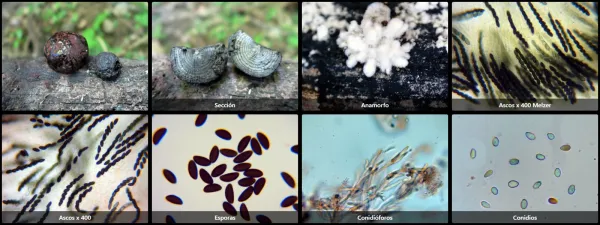
Daldinia concentrica
Taxonomy
Main synonym
Common names
Bola de carbón, kimo mamizebratu.
Geographic references:
Interactive map with data from GBIF.





Morphological Features:
Carpophore sessile, formed by stromata with an irregularly globose or hemispherical shape, with a diameter that varies considerably; some specimens barely reach 1.5 or 2 cm, while others may approach 5 cm. The surface is initially rough and rusty-brown, dotted with ostioles visible only under a magnifying glass, later becoming completely smooth and glossy black.
Hymenium smooth but dotted with ostioles; this visible portion caps the perithecia, forming a layer approximately 1 mm thick in the peripheral zone of the carpophore, with a covering resembling charcoal. It is within these perithecia that the asci are housed, which upon maturity release spores through the ostioles.
Flesh which is actually a trama with a consistency similar to charcoal, virtually weightless, composed of a series of well-differentiated layers visible in cross-section. In young specimens, light grayish or silvery layers alternating with very black ones are clearly visible, arranged concentrically; however, in older specimens the color is more uniformly dark brownish-black, although the distinct layers remain discernible.
Habitat:
A species that fruits on dead wood of various broadleaf trees, from riparian trees such as poplar or ash to oaks. It typically appears in more or less numerous clusters on branches or stumps, sometimes on standing diseased trees. It is not an overly frequent or abundant fungus, although it occurs with considerable regularity in the northern part of the Iberian Peninsula. It does not have a specific fruiting season, appearing almost year-round if conditions are optimal.
Observations:
This species is relatively easy to identify once a cross-section is made, revealing its stratified and concentric trama. Some species of the genus Hypoxylon have similar shapes and coloration, but are much smaller and lack this type of trama. Daldinia vernicosa is a practically identical species; it possesses a small stipe and larger spores, otherwise it matches the species described in this profile.