
Dactylosporina kuehneri
Taxonomy
Main synonym
Common names
Not available
Geographic references:
Interactive map with data from GBIF.



Morphological Features:
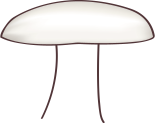
Pileus of reduced dimensions, its diameter ranges between 0.5 and 1.5 (2) cm; in the case of our collection it was 9 mm. It has a dark color, distinctly brown in the center and more or less dark brown elsewhere, initially campanulate, then convex, and finally flattened, maintaining a raised central zone with a blunt umbo. It is velutinate and entirely covered by white hyaline hairs of variable density depending on the region, much denser and longer at the margin and sparser in the center. Margin incurved in young specimens and non-striate, as it is not a hygrophanous species.
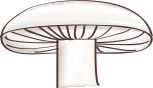
Lamellae adnate, whitish in color, distinctly separated and with lamellulae, some bifurcated in our collection, but more commonly anastomosing and intervenose, rather broad for such a small species and somewhat ventricose. The spore print is white.
Stipe cylindrical but terminating in a pseudorhiza, slightly lighter in color than the pileus, grayish-brown, covered like the latter with whitish hyaline hairs over the entire exposed surface, except on the pseudorhiza. It is disproportionately elongated relative to the pileus diameter.
Flesh insignificant; it is a fragile species with virtually no flesh, nor does it have an appreciable taste or a distinctive odor worthy of mention.
Habitat:
This is a very rare and difficult-to-locate species for which a habitat in wet sandy areas under deciduous trees or various shrub species is referenced; there is no common link in this regard among the different and scarce records, only the sandy or marshy ground. In our case, it was found attached to a mud-covered stone in a very wet and stony area near a riverbed, where Alnus glutinosa predominates. Only a single specimen was located, as is the case with all records up to the date of publication of this entry.
Observations:
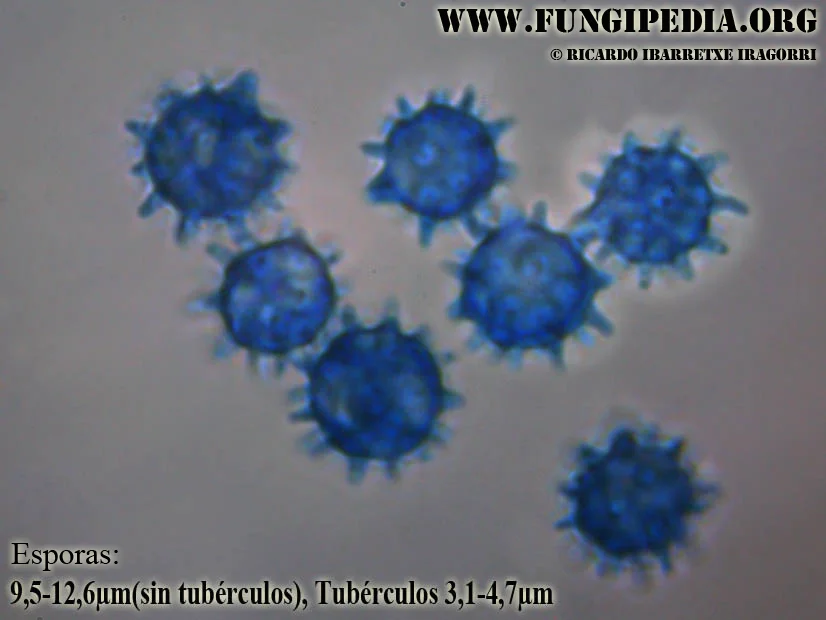
First published record for this species in the Basque Country and probably also for Spain; very few records are known at the European level, with only one published in Austria, one in Germany, two in the Netherlands, and three in France. Obviously, it is a very rare species that always occurs solitarily, first described as Mycenella by Romagnesi in 1941, and has passed through several genera, Oudemansiella, Xerula, and finally Dactylosporina, separated from Xerula for species with tuberculate spores. Macroscopically very similar to Xerula caussei, which however has ellipsoid, non-tuberculate spores.
Microscopy of Dactylosporina kuehneri