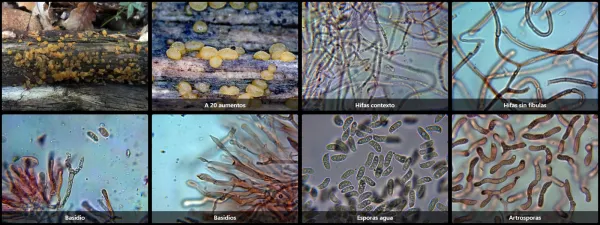
Dacrymyces stillatus
Taxonomy
Main synonym
Common names
Dacrimice delicuescente.
Geographic references:
Interactive map with data from GBIF.





Morphological Features:
Basidiocarp resupinate, very small in size; at most about 3 mm wide, protruding from the substrate by a similar amount. Two forms of this species exist: the primary and the conidial or anamorphic form. In the former case, the surface appears folded to cerebriform, with somewhat irregular folds. The primary form is yellow, later turning orange, whereas in the second phase it is a very bright reddish-orange, and its shape is more pustulate and less folded, resembling a disc.
Hymenium smooth, immersed within the surface of the basidiocarp.
Stipe generally absent; this is a sessile species that attaches directly to the substrate, although exceptionally it may bear a minute and rudimentary stipe.
Flesh yellowish and of gelatinous consistency, lacking any appreciable odor or taste.
Habitat:
Grows on fallen branches or generally dead wood, forming colonies of numerous individuals, with a preference for coniferous wood but not exclusively. It is commonly encountered in our forests as it is frequent and highly abundant, and can be found practically year-round.
Observations:
The primary form of this species has long been classified as Dacrymyces deliquescens, reserving the name stillatus for the reddish-orange individuals. It has been demonstrated that these are indeed two forms of the same species, a primary and a conidial form, in which the basidia are replaced by asexual cells called conidiospores. Therefore, the taxon Dacrymyces deliquescens has ceased to exist as such. This genus is characterized by septate spores and forked bisporic basidia bearing two enormous sterigmata. The species under consideration differs from similar taxa, such as Dacrymyces capitatus, by the thick walls of its spores.