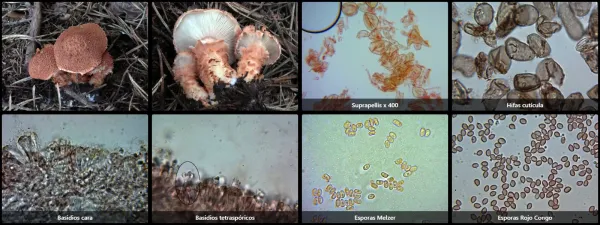

Cystodermella cinnabarina
Taxonomy
Main synonym
Common names
Cistoderma de color cinabrio, galanperna zinabriokolore.
Geographic references:
Interactive map with data from GBIF.


Morphological Features:
Pileus large for its genus, yet it does not reach 10 cm in diameter, transitioning during development from bell-shaped to convex, and finally plane. It is cinnabar-red, sometimes slightly fading towards orange tones, and bears small granulations over almost its entire surface, perhaps with the exception of the central area, where it occasionally presents a small umbo. Margin undulate, but it typically lacks the lacerate or fringed edge seen in other species of its genus.
Lamellae adnate to free, very narrow and quite crowded, fundamentally white in color, becoming somewhat cream-colored with age.
Stipe central and cylindrical, proportional to the pileus size, solid and slightly bulbous at the base. It bears a white ring that divides the stipe into a paler upper portion, and a lower zone concolor with the pileus, covered in scales or granulations, but not forming a distinct annular zone.
Flesh somewhat soft, white in color, yellowing at the stipe base, with a practically null odor and an insignificant taste.
Habitat:
Fruiting on the soil of various forests, with a preference for damp and mossy areas. It should be considered an infrequent or rare species, fruiting during the autumn months.
Observations:
No species of Cystoderma is recommended for consumption, although this particular species is innocuous and lacks the unpleasant odor or taste characteristic of, for example, the yellowish Cystoderma amianthinum. It may be relatively easily confused with Cystodermella granulosa due to the pileal granules; however, that species exhibits a more brownish coloration, a more fringed pileus margin, and a well-defined annular zone on the stipe. A paler variety exists compared to the type species.