
Cystodermella ambrosii
Taxonomy
Main synonym
Common names
Not available
Geographic references:
Interactive map with data from GBIF.


Morphological Features:
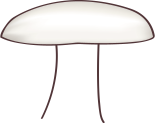
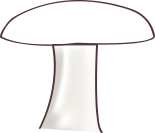
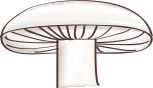
Pileus of a size similar to other Cystodermas, 2 to 6 cm in diameter, hemispherical in its initial stage, becoming convex thereafter, and finally flattening out. It is white in color, although older specimens often exhibit a slightly yellowish center. It has a very dry appearance and is covered over its entire surface by prominent concolorous or slightly grayish granules. The margin bears fringes of the same color.
Lamellae white, adnate or more rarely free, fairly crowded and sinuous.
Stipe approximately 0.5 cm thick by slightly more than 5 cm tall, more or less cylindrical or slightly bulbous. Similar in color to the pileus, although smooth above the ring and covered below with concolorous floccose scales. Its ring is lacerate and tends to disappear over time. It is solid when young but becomes hollow rapidly.
Flesh not very dense, white in color, with a faint odor and taste.
Habitat:
A very rare species that fruits in mossy areas under larches during autumn.
Observations:
This extremely rare species was first described by Bresadola; we have only observed it on one occasion, under larches. We have no references to it beyond what Bruno Cetto notes in his work, leading us to understand that it is native to this exclusive habitat. Confusion with other mushrooms of its genus is unlikely given its morphology; only Cystoderma carcharias is whitish, but its pinkish tones and foul odor distinguish it perfectly.