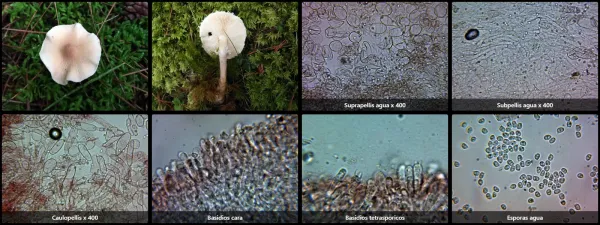

Cystoderma carcharias
Taxonomy
Main synonym
Common names
Cistoderma denticulado, galanperna arrosa.
Geographic references:
Interactive map with data from GBIF.


Morphological Features:
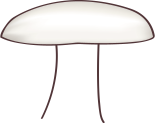
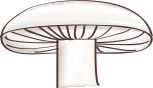
Pileus of small dimensions, barely exceeding 5 cm in diameter, initially bell-shaped, soon becoming convex and finally flattened, retaining a more or less obtuse umbo at the center in most cases. Whitish to pale pink in color, provided with inconspicuous granulations of a farinose appearance. The margin is usually furnished with farinose fimbriae of the same color, which sometimes disappear due to rain.
Lamellae adnate to decurrent by a tooth, white in color, though staining cream or yellowish with age, somewhat unequal and crowded.
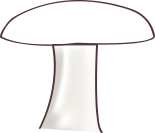
Stipe cylindrical, somewhat longer than the pileus diameter. White and smooth above the ring, which is membranous and funnel-shaped, white above and slightly soiled below. From the ring to the base, it is adorned with granulations of the same color as the pileus. The base is usually slightly bulbous.
Flesh thin and somewhat soft, whitish in color. Odor not very strong but unpleasant, taste also unpleasant.
Habitat:
A rather uncommon species that typically appears preferentially in coniferous forests, although it may also occur less abundantly in other forest types. Its most common fruiting season is autumn.
Observations:
We consider that this species is relatively easily distinguished from others in its genus by the pinkish-white color of the entire basidiome; only the rare Cystodermella ambrosii is white, but it is much more heavily ornamented. It is considerably more difficult to differentiate it from some small Lepiota species, such as Lepiota erminea or Lepiota oreadiformis; it may also be confused with certain Cystolepiota species.