
Cystoderma amianthinum
Taxonomy
Main synonym
Common names
Cistoderma amiantina.
Geographic references:
Interactive map with data from GBIF.


Morphological Features:
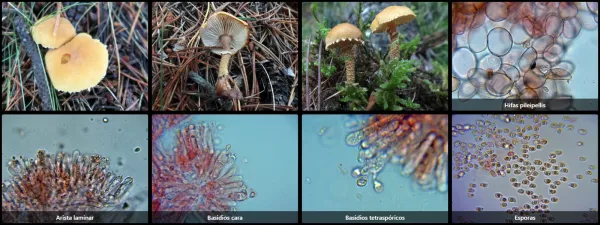
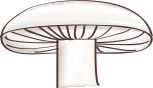
Pileus rarely exceeding 5 cm in diameter, ochre-yellow, slightly darker at the center, scaly or granular, with the margin covered by veil remnants appearing as teeth or fringes. Initially bell-shaped, then convex, finally becoming more flattened, sometimes with an obtuse umbo.
Lamellae white to slightly cream-colored, crowded with interspersed lamellulae, adnate, with a concolorous margin.
Stipe central, cylindrical and elongated, bearing a farinose ring below which extends a skirt-like zone of the same color as the pileus; above the ring, the stipe is smooth and paler in color.
Flesh thin and delicate, yellow in color; curiously, its taste is mild, contrasting with its strong and highly unpleasant odor.
Habitat:
Fundamentally found under pines, although it can also be encountered in other coniferous forests. Its peak fruiting period is autumn, but it has also been observed during very rainy springs; it is a frequent and widely distributed species.
Observations:
This species lacks culinary value. It can be easily confused with several other Cystoderma species, particularly Cystoderma jasonis = Cystoderma longisporum, which has more elongated spores, a less yellow coloration, a membranous ring, lamellae with pinkish tints, and is odorless.