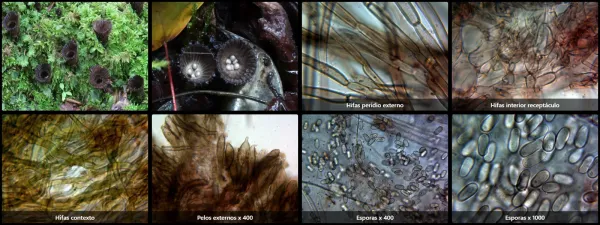

Cyathus striatus
Taxonomy
Main synonym
Common names
Ciato estriado, habia idaskatu, nivets.
Geographic references:
Interactive map with data from GBIF.


Morphological Features:
Basidiocarp composed of fruiting bodies slightly over 1 cm high by approximately the same in width, initially closed and globose, covered with characteristic hairs that are sometimes bristly. Upon dehiscence, it forms a membranous structure that eventually ruptures. In its mature state, it exhibits a bird's nest morphology with a truncate-conic base, differentiating three distinct strata in its peridium: an outer zone covered with brown or reddish-brown hairs, a whitish membrane that completely disappears over time, and an internal surface that is striate or grooved and gray.
Gleba composed of tiny, dark gray egg-like structures, technically termed peridioles, which are lenticular in shape and barely exceed 1 mm in size. There are typically approximately 15 peridioles per specimen, each attached by a single filament to the wall or endoperidium.
Stipe absent; sessile.
Flesh insignificant, lacking any notable odor or taste.
Habitat:
A relatively frequent species that fruits throughout most of the year, possibly except during winter. It occurs on woody debris from both conifers and broadleaf trees, exhibiting a saprotrophic ecology.
Observations:
Other species exist that resemble bird's nests in shape and contain egg-like structures within. Its grooved or striate interior distinguishes it from Cyathus olla, which has a smooth interior; furthermore, the outer covering lacks such bristly hairs. Cyathus stercoreus, of essentially coprophilous habitat, also possesses a smooth endoperidium.